

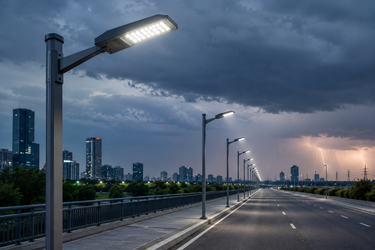
Surge Protection Devices (SPD) in LED Street Lights: Why 10KV/20KV is Essential for Public Tenders
Power surges are one of the most overlooked reasons why outdoor lighting projects fail long before their expected service life. A new LED street light may deliver excellent brightness and energy efficiency, but without proper LED street light surge protection, even a brief voltage spike caused by lightning or switching events can damage drivers, shorten fixture life, or lead to costly maintenance across an entire road network.
That's why more municipalities and engineering consultants are paying closer attention to surge protection specifications when evaluating products for public infrastructure projects. If you've ever wondered why so many tenders specifically ask for 10KV or even 20KV surge protection, the answer goes far beyond simply meeting a technical requirement. It directly affects project reliability, maintenance costs, and long-term performance. So, what makes these ratings so important?
What Causes Power Surges in Municipal Street Lighting Networks?
Municipal lighting systems operate in challenging electrical environments. Unlike indoor lighting, outdoor installations are constantly exposed to weather conditions, long transmission lines, and heavy electrical equipment. Even when lightning doesn't strike a street light directly, nearby electrical disturbances can generate transient overvoltages capable of damaging sensitive LED components.
Common sources of power surges include:
- Indirect lightning strikes: Nearby lightning can induce high-voltage surges that travel through overhead or underground power lines.
- Grid switching operations: Utilities frequently switch transformers, feeders, or substations, creating temporary voltage spikes.
- Large electrical loads: Industrial machinery, elevators, pumps, or nearby construction equipment can introduce transient disturbances into the distribution network.
- Power restoration after outages: Sudden reconnection of electrical service often produces brief but significant surge events.
- Poor grounding systems: Inadequate grounding prevents excess energy from dissipating safely, increasing the risk of component failure.
For a typical street light project, these events are not rare exceptions—they are expected operating conditions. That's why engineers design outdoor lighting systems with multiple layers of electrical protection instead of relying solely on the LED driver.
Unlike traditional high-pressure sodium fixtures, modern LED luminaires contain sophisticated electronic drivers, control circuits, and optional smart lighting modules. These components deliver excellent efficiency but are also much more sensitive to transient voltage than conventional lighting technologies. Without dedicated outdoor lighting surge protection, a single surge can permanently damage the driver while leaving the LEDs themselves intact.
In large municipal projects, widespread driver failures increase maintenance costs, create traffic safety concerns, and reduce overall system reliability.
The Difference Between 10KV and 20KV SPD Ratings
One of the most common questions during project evaluation is whether a 10KV SPD street light is sufficient or if a 20KV protection level is necessary. The answer depends on installation conditions, local climate, and project specifications.
SPD, or Surge Protection Device, is designed to divert excessive transient voltage away from sensitive electronic components before damage occurs. The higher the surge rating, the greater the amount of surge energy the device can safely withstand.
| SPD Rating | Typical Application | Protection Level |
|---|---|---|
| 6KV | Residential or low-risk outdoor lighting | Basic protection |
| 10KV | Urban municipal roads, commercial streets, most public projects | Enhanced protection |
| 20KV | High-lightning regions, highways, airports, coastal infrastructure, critical facilities | Maximum protection |
A 10KV SPD street light has become the minimum expectation for many municipal projects because it provides a balanced combination of protection, cost, and long-term reliability. It performs well in most urban environments where indirect lightning and grid disturbances occur regularly.
A 20KV SPD is typically specified for projects facing higher electrical risks, including:
- Coastal cities with frequent thunderstorms
- Mountainous regions prone to lightning activity
- Highways with long power distribution lines
- Ports and airports
- Industrial zones with large electrical equipment
- Smart city lighting systems requiring maximum uptime
It's important to understand that surge protection ratings should never be viewed as marketing numbers alone. They should align with the environmental risks and the municipal street light specifications outlined in the project documents.
Although a higher-rated SPD slightly increases the initial cost, it often lowers total ownership costs by reducing driver replacements and maintenance over the fixture's service life.
In many international tenders, specifying 10KV or 20KV surge protection has therefore become less about exceeding minimum requirements and more about ensuring dependable operation under real-world conditions.
How SPD Prevents Mass Failure of LED Drivers
The LED driver is often described as the "heart" of an LED luminaire. It converts incoming AC power into stable DC current, regulates output, and protects the LEDs from electrical fluctuations. While LED chips can last 50,000 to 100,000 hours under normal operating conditions, the driver is usually the first component to fail when exposed to repeated voltage surges.
This is exactly where a properly selected Surge Protection Device (SPD) makes a significant difference.
An SPD continuously monitors the electrical line. Under normal operating conditions, it remains inactive and has virtually no effect on system performance. When a voltage spike appears on the power line, the SPD creates a low-resistance path that redirects the surge away from sensitive electronic components, significantly reducing the risk of driver damage.
Without adequate protection, the surge travels directly into the driver, where it may damage sensitive components such as:
- Capacitors
- MOSFETs
- Rectifier circuits
- Control ICs
- Communication modules used for smart lighting
Once these components fail, the entire luminaire often stops working, even though the LED chips themselves remain in excellent condition.
In municipal projects with hundreds of luminaires, the same surge event can damage multiple drivers simultaneously.
Without sufficient LED street light surge protection, this can result in:
- Simultaneous driver failures across entire road sections
- Increased emergency maintenance costs
- Traffic safety concerns caused by dark roadways
- Higher labor and equipment expenses
- Project downtime that affects public services
This phenomenon is commonly referred to as "mass driver failure," and it is one of the primary reasons public authorities increasingly specify higher SPD ratings in procurement documents.
A high-quality led street light should therefore integrate surge protection as part of the overall electrical design rather than treating it as an optional accessory.
Beyond selecting the correct SPD rating, manufacturers should also consider other protective design features, including:
- Optimized grounding paths for faster energy dissipation
- High-quality LED drivers from internationally recognized brands
- Stable die-cast aluminum housings that improve heat management
- Waterproof cable glands and connectors
- High IP and IK ratings to reduce environmental stress on electrical components
These elements work together to create a more resilient luminaire capable of maintaining stable performance throughout its service life.
For projects incorporating smart lighting systems, surge protection becomes even more critical. Wireless controllers, photocells, NEMA sockets, Zhaga connectors, and remote monitoring modules all contain sensitive electronics that can be affected by transient voltage. Protecting only the driver is no longer enough—modern luminaires require comprehensive electrical protection for every integrated component.
Checking Tender Requirements for Street Light Surge Protection
Public lighting tenders rarely focus on price alone. Engineers and procurement teams evaluate whether each luminaire complies with detailed technical specifications designed to ensure reliable long-term performance.
Surge protection is one of the specifications that should never be overlooked.
Before submitting a quotation for any street light project, manufacturers and contractors should carefully review whether the tender defines minimum SPD requirements.
Typical items to verify include:
- Required SPD rating (commonly 10KV or 20KV)
- Compliance with IEC surge testing standards
- Internal or external SPD configuration
- Replaceable surge protection modules
- Driver compatibility
- Earthing and grounding requirements
- Warranty coverage related to surge protection
Some tenders simply specify "minimum 10KV surge protection," while others may require 20KV protection for fixtures installed in high-risk environments such as highways, airports, coastal roads, or industrial parks.
Procurement teams should also avoid assuming that all surge protection solutions are identical. Two luminaires may both claim to offer 10KV protection, yet differences in SPD quality, installation method, grounding design, and overall electrical engineering can lead to very different real-world performance.
When evaluating suppliers, it is worth asking questions such as:
- Is the SPD tested according to internationally recognized standards?
- Is the surge protection integrated into the luminaire or added externally?
- Can the SPD be replaced without replacing the entire fixture?
- Does the manufacturer provide surge test reports?
- Is the warranty supported by documented quality control procedures?
For OEM and ODM projects, surge protection can also be customized to meet local utility requirements or project-specific standards. This flexibility is particularly valuable for distributors, contractors, and engineering companies serving different regions with varying lightning risks and electrical regulations.
Ultimately, selecting a luminaire that exceeds the minimum municipal street light specifications can significantly reduce maintenance costs over the life of the project while improving overall system reliability.
Conclusion
Reliable outdoor lighting is about much more than brightness or energy efficiency. A well-designed luminaire must also withstand the electrical challenges of real-world operation.
Whether a project specifies a 10KV SPD street light or requires 20KV protection, choosing the appropriate LED street light surge protection helps protect LED drivers, reduce maintenance costs, and ensure long-term system reliability. For municipalities, contractors, and infrastructure investors, it is an investment that pays for itself through fewer failures and lower lifecycle costs.
At Infralumin, we design commercial and municipal LED lighting solutions with reliability at the core. Our LED street lights combine high-performance surge protection, premium international components, robust die-cast aluminum construction, high IP/IK protection, and flexible OEM/ODM capabilities to help customers meet demanding public tender requirements worldwide.
Frequently Asked Questions
What is LED street light surge protection?
LED street light surge protection uses a Surge Protection Device (SPD) to divert transient overvoltage away from sensitive electronics, protecting LED drivers and extending fixture lifespan.
Is a 10KV SPD street light enough for municipal projects?
In many urban environments, a 10KV SPD street light meets standard municipal requirements. Projects in high-lightning or critical infrastructure areas often require 20KV protection.
Is 20KV surge protection always better than 10KV?
Not necessarily. A 20KV SPD provides higher protection against severe surges, but the appropriate rating depends on local lightning activity, grid conditions, and municipal street light specifications. Choosing the right protection level helps balance reliability and project cost.
Do all municipal street light specifications require surge protection?
Most modern municipal street light specifications include minimum surge protection requirements, commonly 10KV or 20KV, depending on the project environment.
Can surge protection reduce maintenance costs in a street light project?
Yes. Proper LED street light surge protection reduces driver failures, minimizes maintenance visits, and improves long-term reliability across any large street light project.

Zhongshan Lumin Technology Co., Ltd. is a renowned high-tech enterprise specializing in the research, development, and manufacturing of industrial LED lights.
Contact
@2026 Zhongshan Lumin Technology Co., Ltd.