

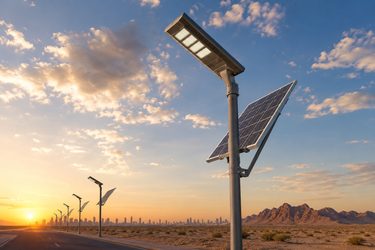
Overcoming Extreme Heat: How LiFePO4 Thermal Management Protects Solar Street Lights
Outdoor solar lighting has become a practical choice for roads, industrial parks, parking lots, and municipal projects. But when installations are exposed to summer temperatures above 45°C (113°F)—common across the Middle East, North Africa, and other desert regions—the battery often becomes the weakest link. That's why choosing a LiFePO4 solar street light is no longer just about energy storage; it's about long-term reliability, safety, and lower maintenance costs.
Extreme heat doesn't simply reduce battery capacity overnight. It accelerates chemical aging, increases internal resistance, and puts additional stress on every charging cycle. Without proper battery chemistry and thermal protection, even a high-quality street light with led technology may experience shorter runtime, reduced service life, or unexpected failures. So, what makes LiFePO4 batteries far better suited for harsh climates, and how do modern thermal management systems keep them operating safely year after year?
How High Temperatures Degrade Lithium Batteries in Solar Lights
Solar street lights spend their entire service life outdoors, where they face direct sunlight during the day and high ambient temperatures for extended periods. Inside an enclosed housing, battery temperatures can rise well above the surrounding air temperature, especially in locations with intense solar radiation.
Heat accelerates the chemical reactions inside lithium batteries. While these reactions are necessary for charging and discharging, excessive temperatures speed up unwanted side reactions that permanently reduce battery performance.
Some of the most common effects include:
- Faster electrolyte degradation, leading to reduced battery capacity.
- Increased internal resistance, which lowers charging and discharging efficiency.
- Accelerated aging of electrodes, shortening the battery's cycle life.
- Higher risk of swelling or thermal instability in unsuitable battery chemistries.
- Reduced nighttime lighting duration due to lower available energy storage.
For a high temperature solar street light, these issues can quickly translate into higher maintenance costs and more frequent battery replacements. Municipal authorities and project contractors often underestimate how much local climate affects total ownership costs. A battery that performs well in moderate temperatures may fail much earlier in desert environments.
Another important factor is the charging process. Solar panels continue generating electricity even under extreme heat. Without effective solar light battery thermal management, excessive battery temperatures during charging can further accelerate degradation. Instead of maximizing battery life, the charging process itself may contribute to long-term damage if the system lacks intelligent protection.
This is why battery chemistry matters just as much as LED efficiency. A premium lighting fixture alone cannot compensate for a battery that is poorly suited to high-temperature operation.
LiFePO4 vs. Li-ion: Which Is Safer for Hot Climates Like the Middle East?
Not all lithium batteries perform the same under heat. While several lithium-ion chemistries are available, LiFePO4 has become the preferred option for commercial solar lighting projects because of its superior thermal stability.
| Feature | LiFePO4 Battery | Conventional Li-ion Battery |
|---|---|---|
| Thermal stability | Excellent | Moderate |
| Operating temperature tolerance | High | Lower |
| Thermal runaway resistance | Very high | Lower |
| Typical cycle life | 3,000–6,000+ cycles | 500–1,500 cycles |
| Safety under continuous heat | Excellent | Good to Moderate |
| Suitable for Middle East projects | Highly recommended | Depends on application |
The main difference lies in the battery's chemical structure. LiFePO4 uses lithium iron phosphate as the cathode material, which remains chemically stable even under elevated temperatures. Conventional lithium-ion batteries, such as those using nickel-rich chemistries, generally provide higher energy density but are more sensitive to heat stress.
For Middle East solar lighting projects, this distinction becomes especially important. Outdoor fixtures may experience months of continuous high temperatures, with battery compartments reaching 60°C or higher under direct sunlight. Under these conditions, thermal stability becomes a critical safety requirement rather than simply a performance advantage.
LiFePO4 batteries also offer:
- Longer service life with significantly more charge-discharge cycles.
- Better capacity retention after years of outdoor operation.
- Lower risk of overheating during rapid charging.
- Improved operational safety for unattended public lighting.
- More predictable performance across changing environmental conditions.
These advantages explain why many infrastructure projects, smart city developments, highways, and industrial facilities increasingly specify LiFePO4 solar street light systems as part of their procurement requirements.
Although the initial investment may be slightly higher than standard lithium-ion solutions, the reduced maintenance frequency and extended battery lifespan typically result in a lower total cost of ownership throughout the project's lifecycle.
Passive Cooling Designs in All-in-One Solar Street Light Housings
Battery chemistry alone cannot ensure reliable operation in extreme environments. The physical design of the fixture also plays a major role in temperature control.
Unlike actively cooled electronic equipment, most solar street lights rely on passive cooling. This approach uses carefully engineered structural components to dissipate heat naturally without requiring fans or additional power consumption.
An effective passive cooling design typically includes several key elements.
High Thermal Conductivity Aluminum Housing
Die-cast aluminum is widely used because it transfers heat away from internal electronic components efficiently. Compared with plastic housings, aluminum helps distribute heat more evenly, preventing localized hot spots around the battery and LED driver.
Optimized Heat Sink Structure
Well-designed cooling fins increase the surface area exposed to surrounding air, allowing heat to dissipate more effectively through natural convection. This improves overall operating stability while maintaining a compact fixture design.
Intelligent Internal Layout
Separating the battery, LED module, driver, and control electronics reduces heat transfer between components. Batteries remain cooler when they are isolated from the primary heat sources generated during nighttime lighting operation.
Reflective Surface Treatments
Some manufacturers apply specialized coatings or lighter-colored finishes that reduce solar heat absorption during daytime exposure. Although often overlooked, surface treatment can contribute to lower internal operating temperatures over the long term.
These structural improvements work together to support effective solar light battery thermal management, helping maintain battery performance without introducing additional mechanical components that could require maintenance.
Heat management extends beyond the battery itself. During operation, the LED module and driver also generate heat, which can gradually raise the internal temperature if the fixture is not properly designed. An optimized thermal path helps transfer this heat efficiently from internal components to the outer housing, reducing thermal stress across the entire lighting system.
When selecting a high temperature solar street light, buyers should consider features such as:
- Die-cast aluminum housing with excellent heat dissipation
- IP66 or IP67 weather protection
- IK08 or IK09 impact resistance
- High-efficiency LED drivers that generate less waste heat
- Tool-free maintenance design
- Separate thermal zones for the battery and LED module
Together, these design features improve long-term reliability, extend battery life, and reduce maintenance costs. Combined with LiFePO4 battery technology, they help ensure stable performance even in demanding outdoor environments.
BMS (Battery Management System) Role in Preventing Thermal Runaway
While passive cooling helps reduce heat buildup, the Battery Management System (BMS) acts as the intelligent safeguard that continuously monitors and protects the battery throughout its operating life.
A modern BMS constantly measures critical parameters, including battery voltage, current, state of charge, and temperature. If any value exceeds the predefined safety range, the system automatically adjusts charging or discharging behavior to prevent damage.
For a LiFePO4 solar street light, the BMS provides several layers of protection:
- Overcharge protection to prevent excessive charging during strong sunlight.
- Over-discharge protection to avoid deep battery depletion that shortens cycle life.
- Temperature monitoring that limits charging or discharging when battery temperatures become too high.
- Cell balancing to ensure every battery cell charges and discharges evenly, maximizing overall lifespan.
- Short-circuit and overcurrent protection to reduce the risk of electrical faults.
One of the BMS's most important functions is preventing thermal runaway.
Thermal runaway is a chain reaction in which rising temperatures cause the battery to generate even more heat, potentially leading to permanent damage or, in severe cases, fire. Although LiFePO4 chemistry is inherently more resistant to thermal runaway than many other lithium-ion batteries, intelligent electronic protection remains essential for maximizing safety.
In real-world applications, the BMS also improves lighting performance. During prolonged heat waves, it can optimize charging strategies to reduce battery stress rather than simply forcing maximum charging current whenever sunlight is available. This intelligent control helps preserve battery capacity over thousands of charging cycles.
For large-scale Middle East solar lighting projects, where maintenance visits can be expensive and installations may be located in remote areas, a reliable BMS is just as important as the quality of the battery itself.
Choosing Solar Street Lights for Hot Climate Projects
When specifying outdoor lighting for regions with extreme temperatures, focusing solely on lumen output or battery capacity can be misleading. Long-term reliability depends on how well the entire system manages heat.
A high-quality street light with led technology should combine:
- LiFePO4 batteries with excellent thermal stability
- Intelligent BMS protection
- Efficient passive cooling through die-cast aluminum construction
- High IP and IK ratings for harsh outdoor environments
- High-performance LED drivers with low heat generation
- Durable optical design that maintains lighting performance over time
These elements work together to extend battery life, improve safety, and reduce maintenance costs throughout the project's lifespan.
Conclusion
Extreme heat is one of the biggest challenges facing outdoor solar lighting installations. While no battery is completely unaffected by high temperatures, combining LiFePO4 battery technology with effective thermal management dramatically improves long-term reliability and operational safety.
For projects in high-temperature regions, choosing the right battery technology is only the first step. A well-designed thermal management system determines how reliably a solar street light performs over years of continuous outdoor operation.
At Infralumin, we combine LiFePO4 batteries, intelligent BMS protection, premium LED components, and robust die-cast aluminum housings to deliver OEM/ODM solar lighting solutions built for demanding commercial and municipal applications. If you're planning a project in extreme climates, our engineering team can help you select the right solution for long-term performance.
Frequently Asked Questions
Is a LiFePO4 solar street light suitable for desert climates?
Yes. A LiFePO4 solar street light offers excellent thermal stability, making it one of the safest and most reliable choices for hot environments such as desert and Middle East projects.
Why is LiFePO4 safer than conventional lithium-ion batteries?
LiFePO4 batteries have a more stable chemical structure, providing better resistance to overheating and a significantly lower risk of thermal runaway.
How does solar light battery thermal management improve battery life?
Effective solar light battery thermal management reduces excessive heat buildup, helping slow battery aging and maintain higher capacity over thousands of charging cycles.
What should I look for in a high temperature solar street light?
Look for LiFePO4 batteries, a smart BMS, die-cast aluminum housing, high IP/IK ratings, and efficient passive cooling to ensure reliable long-term operation.
Why are LiFePO4 batteries popular in Middle East solar lighting projects?
Because they tolerate high ambient temperatures better than many conventional lithium-ion batteries, making them ideal for demanding Middle East solar lighting applications.
Does a street light with led generate heat?
Yes. Although LEDs are highly efficient, they still produce heat. Proper heat sink design and thermal management are essential to maintain lighting performance and protect internal components.

Zhongshan Lumin Technology Co., Ltd. is a renowned high-tech enterprise specializing in the research, development, and manufacturing of industrial LED lights.
Contact
@2026 Zhongshan Lumin Technology Co., Ltd.