

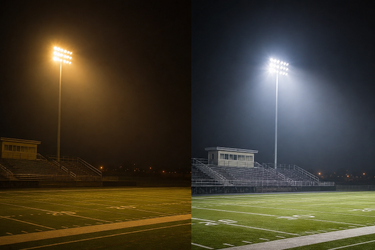
Upgrading Metal Halide to LED for High School Sports Fields: A Cost and ROI Guide
High school sports fields often rely on lighting systems that were installed 15 or even 20 years ago. While those metal halide fixtures may still turn on every evening, they usually consume more electricity than necessary, require frequent lamp replacements, and deliver inconsistent lighting quality over time. That's why many schools are now planning a sports field lighting retrofit instead of simply replacing old lamps one by one.
If you're evaluating whether to replace metal halide with LED stadium lights, the decision is no longer just about brighter lighting. Energy savings, maintenance costs, player safety, and long-term return on investment all play an important role. So how much can a school actually save, and how quickly can an LED upgrade pay for itself?
Energy Consumption Comparison: 1000W MH vs. 400W LED
One of the biggest reasons schools choose to replace metal halide with LED stadium lights is the significant reduction in power consumption without sacrificing illumination.
A traditional 1000W metal halide fixture actually draws more than its rated wattage once ballast losses are included. In many installations, the total system power reaches approximately 1080W–1150W per fixture.
By comparison, a modern 400W LED stadium light can produce a similar or even higher usable light output thanks to:
- Higher luminous efficacy
- Precision optical lens design
- Better light distribution
- Reduced wasted spill light
| Comparison | 1000W Metal Halide | 400W LED Stadium Light |
|---|---|---|
| System Power | 1080–1150W | 400W |
| Warm-up Time | 10–20 minutes | Instant On |
| Restrike After Power Loss | Several minutes | Immediate |
| Light Output Stability | Gradually declines | Consistent over lifetime |
| Rated Lifetime | 10,000–20,000 hrs | 50,000–100,000 hrs |
For a typical high school football field using 60 luminaires, the difference becomes substantial.
Estimated annual energy usage
- Metal Halide:
60 × 1100W
Operating 1,500 hours/year
≈99,000 kWh
- LED:
60 × 400W
Operating 1,500 hours/year
≈36,000 kWh
That represents approximately 63% lower electricity consumption, which directly reduces operating expenses year after year.
Another advantage is that LED systems maintain more stable illumination levels over time. Metal halide lamps gradually lose lumen output as they age, often forcing facilities to over-light the field initially to compensate for future depreciation. LEDs experience much slower lumen depreciation, helping schools maintain more consistent lighting performance throughout the system's service life.
Reduction in Maintenance and Replacement Costs
Electricity savings usually receive the most attention, but maintenance often represents the hidden cost that makes the business case even stronger.
Metal halide fixtures require routine maintenance, including:
- Lamp replacement
- Ballast replacement
- Lift equipment rental
- Labor costs
- Nighttime maintenance scheduling
- Temporary field closures
Because sports field poles commonly exceed 20–30 meters in height, replacing a failed lamp is neither quick nor inexpensive.
A quality LED stadium light dramatically reduces these maintenance requirements. With lifetimes commonly exceeding 50,000 hours, many schools can operate for more than 15 years before major fixture replacement becomes necessary.
Additional maintenance advantages include:
- No lamp relamping schedules
- Fewer unexpected failures
- Lower inventory of spare parts
- Reduced labor hours
- Minimal disruption to sporting events
Many premium LED systems also feature tool-free maintenance designs, allowing drivers or surge protection devices to be serviced quickly without removing the entire fixture. This shortens maintenance time and reduces overall service costs.
For facility managers responsible for multiple campuses, these operational savings often become just as valuable as reduced electricity bills.
Improving Player Safety and Spectator Experience with Flicker-Free LED
Lighting quality directly affects how athletes perform and how spectators enjoy the game.
Older metal halide systems frequently experience:
- Uneven illumination
- Flickering as lamps age
- Longer warm-up periods
- Reduced brightness during cold weather
- Color shifts over time
These issues may not seem critical at first glance, but they can influence visibility during fast-moving sports such as football, baseball, soccer, and lacrosse.
Modern LED stadium light systems solve many of these problems through advanced optical and electrical design.
Key improvements include:
Flicker-Free Performance
High-quality LED drivers deliver stable current output, eliminating visible flicker that can cause eye fatigue, reduce visual comfort, and negatively affect slow-motion video recording.
Better Uniformity
Precision optical lenses distribute light more evenly across the playing surface, reducing dark areas and improving player visibility.
Improved Color Rendering
LED fixtures with higher CRI values help athletes distinguish uniforms, field markings, and moving balls more accurately.
Instant Start
Unlike metal halide lamps, LEDs reach full brightness immediately after power is applied, eliminating long warm-up periods and reducing delays after temporary power interruptions.
Beyond the field itself, better lighting also improves pedestrian areas, entrances, parking lots, and walkways surrounding the venue. Many schools complement their stadium upgrade with an LED outdoor floodlight system to improve safety throughout the campus while maintaining a consistent lighting appearance.
As more schools livestream games or host regional competitions, high-quality LED lighting also supports clearer video production, making the venue more attractive for athletes, families, and local communities.
Payback Period Calculation for a Typical High School Stadium
Every school wants to understand one question before approving a project:
How long will it take for the investment to pay for itself?
Although every project differs, a simplified example illustrates the economics.
Example Project
- Existing fixtures: 60 × 1000W metal halide
- New fixtures: 60 × 400W LED stadium lights
- Annual operating time: 1,500 hours
- Electricity cost: varies by region
- LED fixture life: 50,000+ hours
Annual Savings Typically Come From
- Reduced electricity consumption
- Lower maintenance expenses
- Fewer replacement lamps
- Reduced equipment rental
- Lower labor costs
- Fewer emergency repairs
For many high school projects, the combined annual savings allow the initial investment to be recovered in approximately 4 to 7 years, depending on electricity prices, operating hours, labor rates, and available utility rebates.
The exact stadium lighting ROI should always be calculated using site-specific information such as fixture quantity, pole layout, lighting standards, and local energy costs. A professional lighting simulation can also verify illumination levels before installation, ensuring the new system meets competition requirements while avoiding unnecessary over-lighting.
Instead of evaluating only the upfront high school stadium lighting cost, decision-makers should consider the total cost of ownership over the entire lifespan of the lighting system. In many cases, the long-term savings significantly outweigh the initial investment.
Choosing the Right LED Lighting Partner
Not all LED lighting systems deliver the same long-term value.
When planning a sports field lighting retrofit, buyers should evaluate more than fixture wattage. Important considerations include:
- Die-cast aluminum housing for effective heat dissipation
- High IP66 and IK08/IK09 protection ratings
- Premium LED chips and reliable drivers
- Professional optical lens options for different field sizes
- Surge protection for outdoor installations
- Adjustable CCT and smart lighting controls where required
- OEM/ODM customization capabilities
- Comprehensive photometric design support
Working with an experienced manufacturer helps ensure the lighting solution meets project requirements while maximizing efficiency and long-term reliability.
Conclusion
For schools looking to modernize aging sports facilities, replacing metal halide fixtures with LED technology is more than an energy-saving upgrade. Lower operating costs, reduced maintenance, improved visibility, and stronger long-term stadium lighting ROI make LED a practical investment for both athletic performance and facility management.
At Infralumin, we specialize in commercial and industrial outdoor LED lighting solutions designed for demanding sports applications. From professional lighting design and OEM/ODM customization to reliable, high-performance LED stadium lighting systems, our team is ready to help you build a more efficient and future-ready sports venue.
FAQ
Is it worth replacing metal halide with LED stadium lights?
Yes. Schools can reduce energy consumption, lower maintenance costs, improve lighting quality, and achieve a favorable stadium lighting ROI over the system's lifetime.
How much energy can a sports field lighting retrofit save?
Most projects reduce electricity consumption by approximately 50% to 70%, depending on the existing lighting system and the selected LED stadium light.
How long do LED stadium lights last?
A high-quality LED stadium light typically operates for 50,000 to 100,000 hours, significantly longer than traditional metal halide fixtures.
What affects high school stadium lighting cost?
Fixture quantity, pole height, lighting level requirements, control systems, installation complexity, and local labor costs all influence the overall high school stadium lighting cost.
Can LED outdoor floodlight fixtures be used around sports facilities?
Yes. LED outdoor floodlight products are commonly installed in parking lots, walkways, entrances, and surrounding areas to improve campus safety and maintain consistent outdoor illumination.
What should be considered before a sports field lighting retrofit?
Lighting simulations, pole conditions, electrical infrastructure, required illumination standards, and long-term maintenance requirements should all be evaluated before starting a sports field lighting retrofit.

Zhongshan Lumin Technology Co., Ltd. is a renowned high-tech enterprise specializing in the research, development, and manufacturing of industrial LED lights.
Contact
@2026 Zhongshan Lumin Technology Co., Ltd.