

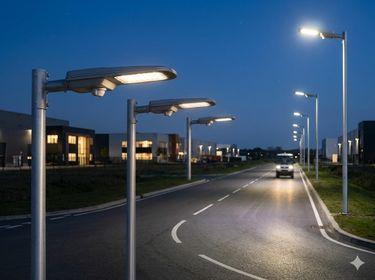
Smart Dimming for LED Street Lights: Control Options and Energy Savings
Municipalities and facility managers are facing unprecedented pressure to cut operational costs while maintaining public safety. Upgrading old high-pressure sodium fixtures to LED technology was a massive leap forward, but leaving those new fixtures running at 100% brightness at three in the morning on an empty road is a missed opportunity. This is where modern infrastructure needs to evolve. Implementing smart LED street light dimming changes the equation entirely, turning a static grid into an adaptive, energy-saving network. But with so many control protocols, sensor types, and connectivity networks available on the market today, how do you choose the right system for your specific municipal or industrial project?
How midnight-dim profiles reduce LED street light energy use by 30–45% on low-traffic roads
The concept of midnight dimming, often referred to as autonomous or timer-based step dimming, is one of the most effective ways to slash energy consumption without compromising safety. Rather than relying on a centralized control system to send real-time commands, this method utilizes the intelligent LED driver inside the fixture itself. The driver is pre-programmed with a dimming schedule that automatically adjusts the wattage based on the calculated virtual midnight.Because the time of dusk and dawn shifts throughout the year, the intelligent driver measures the total "power on" time from the previous nights, calculates the midpoint, and uses that as the reference for its dimming profile.
The physics behind dimming LEDs offer compounding benefits. When you reduce the power supplied to an LED module by 50%, the perceived light output does not drop by a drastic half due to the non-linear nature of human vision. More importantly, driving the LED chips at lower currents significantly reduces the thermal load on the die-cast aluminum housing. This lower operating temperature slows down lumen depreciation and extends the overall lifespan of both the diodes and the power supply. On typical low-traffic suburban roads or industrial perimeters, a common profile might hold the light at 100% until 10:00 PM, drop to 70% until midnight, reduce to 30% during the quietest hours of 12:00 AM to 4:00 AM, and ramp back up to 70% until dawn.
Implementing this precise, localized control strategy yields an additional 30% to 45% reduction in electricity usage on top of the initial savings gained from the LED upgrade itself. Because this relies entirely on the internal driver hardware and requires no external networking fees, it represents the fastest return on investment for standard road lighting projects.
DALI-2, 0–10V dimming, and built-in PIR sensor: which control option fits which project scale
While standalone driver profiles are excellent for predictable environments, many projects require dynamic control or integration with wider building management systems. Selecting the right protocol is critical for balancing initial hardware costs with long-term functionality.
- 0-10V Analog Dimming: This is the most traditional and straightforward method. The driver receives an analog voltage signal anywhere from 0 to 10 volts, adjusting the light output accordingly. It is highly cost-effective and perfect for smaller, localized areas like parking lots or basic industrial pathways. However, it is a one-way communication street; the fixture cannot report its status or alert you to a driver failure.
- DALI-2 Protocol: The Digital Addressable Lighting Interface (DALI-2) is the global standard for professional lighting control. DALI street light control allows for individual addressing of each fixture and provides vital two-way communication. A central controller can tell a specific pole to dim to 45%, and the pole can report back confirming the action, while also sending diagnostic data on energy usage and thermal performance.
- Reactive Sensors: Integrating an LED street light motion sensor—whether Passive Infrared (PIR) or microwave radar—adds a layer of immediate responsiveness. When motion from a vehicle or pedestrian is detected, the light instantly ramps up from a dimmed background state to full brightness, dropping back down after a set dwell time.
To help visualize the differences, here is a quick comparison of these control mechanisms:
| Control Option | Communication | Best Suited For | Feedback / Diagnostics | Relative Cost |
|---|---|---|---|---|
| 0-10V Dimming | Analog (One-way) | Small parking lots, basic perimeter lighting | None | Low |
| DALI-2 | Digital (Two-way) | Large-scale municipal grids, smart city networks | Detailed (Energy, Faults, Temps) | High |
| PIR / Microwave | Local (Triggered) | Pedestrian paths, cycle lanes, warehouse exteriors | None (unless paired with DALI) | Medium |
When NB-IoT / LoRa centralized management is cost-justified for projects under 500 units
Historically, implementing a Central Management System (CMS) was a luxury reserved for massive metropolitan areas deploying tens of thousands of street lights. The traditional architecture required purchasing expensive local gateways, establishing dedicated RF meshes, and paying hefty software licensing fees, making it financially unviable for small towns, private industrial parks, or university campuses. However, the rise of cellular-based networks has shifted this dynamic completely.
For installations of fewer than 500 units, utilizing NB-IoT street light management is now highly cost-justified due to the elimination of localized gateway hardware.
- Direct-to-Tower Connectivity: Unlike LoRaWAN, which often requires you to set up and maintain your own local gateway to collect data from the light poles, NB-IoT nodes connect directly to existing commercial cellular towers. This means zero local network infrastructure to maintain.
- Maintenance Labor Reduction: In private industrial estates or small municipal districts, the cost of dispatching a bucket truck just to identify which lamp is out is astronomical. NB-IoT systems provide instant, pinpoint fault reporting directly to a dashboard, turning reactive truck rolls into targeted, proactive maintenance.
- Precise Energy Metering: Many utility companies now accept exact energy consumption data from smart nodes rather than charging a flat, estimated tariff based on dusk-to-dawn operation. The ability to prove exactly how much energy was saved through dimming often pays for the node's data subscription fee within the first year.
While LoRaWAN can still be advantageous if a campus already has a gateway established for other smart devices (like water meters or parking sensors), NB-IoT offers the most frictionless path to a true smart grid for standalone lighting projects with smaller fixture counts.
Key warranty and firmware clauses to include in smart street light tenders
Procuring hardware that is intended to last two decades while integrating software that evolves every few months creates a unique challenge for project engineers. The physical luminaire, particularly the die-cast aluminum housing and the optical lenses, must meet strict IP (ingress protection) and IK (impact protection) ratings. But a ten-year hardware warranty on the physical chassis offers little comfort if the smart node operating the fixture becomes obsolete or loses network support after just three years.
When drafting tenders for smart lighting infrastructure, buyers must explicitly separate the mechanical warranty from the firmware and software lifecycle guarantees. Ensure that the contract mandates Over-The-Air (OTA) update capabilities for all smart nodes, guaranteeing that security patches and protocol updates will be pushed to the fixtures without requiring physical intervention. Furthermore, tender documents should mandate the use of standardized receptacles, such as Zhaga Book 18 or NEMA 7-pin sockets. This ensures that if the software provider goes out of business, the municipality or facility manager can simply twist off the old node and install a new one from a different vendor without having to replace the entire LED fixture.
Finally, require a minimum five-year service level agreement (SLA) on the cloud dashboard and cellular connectivity, clearly outlining who absorbs the cost of network sunsets (such as the transition from 4G to 5G). By strictly defining these parameters, you protect the investment from both harsh environmental degradation and rapid digital obsolescence.
Conclusion
Transitioning to intelligent outdoor lighting is no longer just about swapping bulbs; it is about deploying an energy-efficient asset that responds to the actual needs of the environment. Whether you are leaning toward autonomous driver profiles for a rural stretch of road or full NB-IoT integration for a commercial facility, the right technology dramatically lowers total cost of ownership. At Infralumin, we leverage our deep expertise in OEM/ODM manufacturing to build heavy-duty, die-cast aluminum street lights featuring tool-free maintenance and seamless compatibility with the world's leading smart control systems. Partner with us to future-proof your next lighting project.
FAQ
What is the main advantage of smart LED street light dimming?
The primary advantage is the significant reduction in energy consumption and operational costs. By lowering brightness during off-peak hours, you also reduce the thermal strain on the driver and LED chips, directly extending the lifespan of the fixture.
Does DALI street light control require special cabling?
Yes, DALI systems typically require a two-wire control bus alongside the standard power cables. However, in outdoor street lighting, this communication happens internally between the NEMA/Zhaga smart node and the DALI driver inside the fixture, so no extra underground wiring between poles is needed.
How reliable is an LED street light motion sensor in extreme weather?
Modern sensors are highly reliable if chosen correctly. PIR sensors are great for detecting body heat but can be hindered by heavy snow or fog. Microwave radar sensors are often preferred for harsh outdoor environments because they can penetrate glass, plastic, and heavy precipitation to detect movement accurately.
Can NB-IoT street light management work without a local gateway?
Yes. The biggest benefit of NB-IoT technology is that each individual light fixture node contains a SIM card (or eSIM) and communicates directly with local telecom cellular towers, completely bypassing the need for a localized, user-maintained gateway.
Will dimming the street lights affect driver and pedestrian safety?
No, provided the dimming profiles adhere to local roadway standards. Lighting levels are carefully calculated to match traffic volume. When traffic drops to near zero in the early hours of the morning, standard safety visibility can be fully maintained even at 30% to 50% power output.

Zhongshan Lumin Technology Co., Ltd. is a renowned high-tech enterprise specializing in the research, development, and manufacturing of industrial LED lights.
Contact
@2026 Zhongshan Lumin Technology Co., Ltd.