

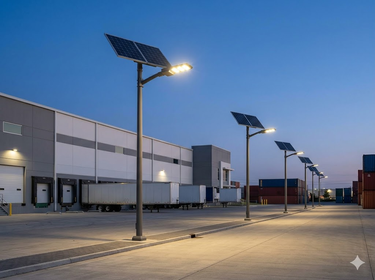
Solar Street Lights for Industrial Parks & Logistics Areas
Facility managers and municipal engineers are increasingly recognizing that outdoor illumination is no longer just a basic utility—it is a critical component of site safety, operational efficiency, and cost management. As energy tariffs fluctuate and sustainability mandates tighten, transitioning to industrial solar street lighting has become a strategic necessity rather than a mere alternative. Modern off-grid systems now rival traditional grid-tied fixtures in lumen output and reliability, thanks to advancements in photovoltaic efficiency and battery storage. For sprawling manufacturing complexes and high-traffic distribution hubs, engineering a self-sustaining lighting network requires a deep understanding of optical design, thermal management, and rugged physical construction.
Industrial Solar Street Lighting for Security Applications
Security in large-scale industrial complexes relies heavily on consistent, uninterrupted visibility. Facility perimeters, access gates, and blind alleys are high-risk zones where power failures or inadequate light distribution can immediately compromise surveillance systems and physical guard patrols. Grid-tied systems are vulnerable to regional outages and targeted cable theft, whereas localized, off-grid systems provide a decentralized safety net. By utilizing independent power generation, each luminaire acts as a standalone asset that remains operational regardless of central grid stability.
Furthermore, integrating intelligent lighting controls transforms these fixtures into active security tools. When engineering these systems, coupling high-efficacy LED chips with microwave or passive infrared (PIR) sensors allows the luminaire to operate at a conservative dimming profile (e.g., 30% output) during idle hours, conserving battery autonomy. Upon detecting movement from vehicles or pedestrians, the fixture instantly scales to 100% illumination. This sudden shift in brightness not only ensures clear visual capture for CCTV cameras but also acts as a psychological deterrent to unauthorized access. The structural integrity of the fixture plays an equally vital role in security; components housed in heavy-duty die-cast aluminum with high impact resistance ensure the hardware cannot be easily incapacitated by vandalism or environmental stress.
Wide-Area Solar Lighting for Logistics Parks
Navigating the operational demands of distribution centers requires meticulous attention to light distribution. Unlike standard municipal roads, logistics hubs feature constant heavy machinery movement, towering storage racks, and wide loading aprons. Deploying solar lighting for logistics demands precision optics to prevent dark spots and minimize glare, which can temporarily blind forklift operators and truck drivers. Utilizing specific optical lenses, such as Type II or Type III light distribution profiles, pushes the light laterally along driveways or forward across wide staging areas, maximizing the effective coverage of every watt consumed.
To establish safe and efficient working environments, lighting designers must adhere to rigorous performance metrics. European standard EN 13201 provides critical guidance for road and public space illumination, but industrial applications require specific illuminance tuning based on the task at hand. Selecting the correct lux level dictates the required lumen package and, consequently, the sizing of the solar panel and battery bank.
| Application Area | Recommended Illuminance | Standard Reference Focus | Engineering Justification |
| Logistics Parks (General Movement) | 50lx | EN 13201 (Modified for private transit) | Sufficient for safe navigation of transport trucks, general forklift movement, and pedestrian walkways. Prevents over-illumination and conserves battery capacity for longer autonomy. |
| Industrial Parks (Loading/Active Tasks) | 100lx | EN 13201 / Specific Occupational Safety | Critical for high-risk zones, such as active loading docks, precise material handling, and security inspection gates. Ensures workers can clearly read shipping labels and operate machinery safely. |
Energy Independence with Solar Street Lights in Industrial Zones
The financial argument for severing reliance on the electrical grid is stronger than ever. According to data from the International Energy Agency (IEA), industrial electricity costs have seen unprecedented volatility in recent years, heavily impacting the operational expenditures (OPEX) of manufacturing facilities. By integrating a commercial solar street light network, facility managers lock in their exterior lighting costs, insulating their budgets from unpredictable tariff hikes.
However, achieving true energy independence requires specifying commercial-grade components that can withstand relentless daily cycling. Consumer-grade solar lights fail rapidly in these environments due to thermal degradation and inferior charge management. A professionally engineered system relies on a tightly integrated architecture:
- Advanced MPPT Controllers:Maximum Power Point Tracking (MPPT) drivers are non-negotiable for industrial lighting. They continuously adjust the electrical operating point of the solar modules, extracting up to 30% more energy during overcast conditions or suboptimal winter angles compared to standard PWM controllers.
- IEC 62133 Certified Energy Storage:The battery is the most critical failure point in any off-grid system. Utilizing Lithium Iron Phosphate (LiFePO4) battery packs that comply with the IEC 62133 safety standard ensures thermal stability and protection against internal short circuits. These batteries safely endure thousands of deep discharge cycles, providing reliable power even after days of inclement weather.
- Adjustable Color Temperature (CCT):Depending on the geographical location and specific site requirements, having tunable CCT allows project engineers to optimize visibility. Warmer temperatures (3000K) cut through fog and minimize ecological impact, while cooler temperatures (5000K) maximize perceived brightness for security cameras.
- Superior Thermal Management:High-output LED chips generate significant localized heat. Premium fixtures utilize heavy-duty heat sinks integrated directly into the die-cast aluminum housing. This passive thermal dissipation protects the driver power supply and prevents lumen depreciation, ensuring the fixture meets its projected 50,000+ hour lifespan.
Engineering the Right Solution: Technical Specifications for Harsh Environments
Industrial and commercial sites expose hardware to severe environmental abuse. Airborne particulates from manufacturing processes, highly corrosive salt fog in coastal logistics ports, and constant mechanical vibrations from heavy transport vehicles all threaten the integrity of outdoor electronics. Consequently, evaluating the Ingress Protection (IP) and Impact Protection (IK) ratings is a foundational step in the procurement process.
The practical significance of an IP66 rating cannot be overstated in an industrial context. The "6" for solid ingress means the luminaire is completely vacuum-sealed against micro-dust, a critical requirement for sites dealing with cement, grain, or chemical processing. The second "6" indicates protection against powerful water jets. In real-world terms, this means the fixture will survive severe typhoons, torrential downpours, and even aggressive high-pressure facility washdowns without internal condensation shorting the driver power supply.
Equally critical is the IK10 rating, representing the highest level of protection against external mechanical impacts. In busy logistics yards, accidental bumps from extended forklift masts, flying debris from severe weather, or routine maintenance collisions are common. An IK10-rated polycarbonate lens and reinforced housing absorb up to 20 joules of impact energy, preventing shattering and internal component damage.
To further optimize the total cost of ownership (TCO) in these demanding environments, leading manufacturers prioritize serviceability:
Tool-Free Maintenance Design:In the event that a driver or battery requires diagnostic checks, tool-free access latches allow technicians to open the fixture housing safely and quickly while on a bucket truck, drastically reducing maintenance labor hours and minimizing site downtime.
Robust Mounting Hardware:Heavy-duty slip fitters and adjustable mounting brackets allow for precise angling of the luminaire, maximizing solar yield on the panel face while directing the optical lens perfectly toward the target illumination zone.
OEM/ODM Customization:True B2B manufacturers offer deep customization, allowing general contractors and project designers to tailor the battery capacity, panel wattage, and intelligent dimming profiles to match the specific geographical solar radiation data of the installation site.
Conclusion
Transitioning to high-performance off-grid illumination is a strategic infrastructure upgrade that directly enhances site safety while permanently eliminating outdoor lighting electricity costs. For complex industrial parks and bustling logistics centers, success relies on deploying fixtures built to exacting technical standards. By prioritizing robust die-cast aluminum construction, rigorous IP66/IK10 ratings, and advanced optical light distribution, facility managers can guarantee long-term reliability. Partnering with an experienced solar street light manufacturer that offers comprehensive OEM/ODM services ensures that every project receives a tailored, intelligent lighting solution designed to perform flawlessly in the world's most demanding commercial environments.
Frequently Asked Questions
How long do industrial solar street lights last before needing replacement?
High-quality systems utilizing die-cast aluminum housings and thermal management typically see the LED chips last over 50,000 to 100,000 hours (10+ years). The LiFePO4 batteries generally require replacement every 5 to 7 years, depending on the depth of discharge and regional temperature extremes.
Can solar street lights operate effectively during continuous rainy or cloudy days?
Yes. Professionally engineered systems are sized based on local solar insulation data. By combining high-efficiency monocrystalline panels, MPPT controllers, and adequate battery sizing, these fixtures are designed to provide 3 to 5 days of autonomy (continuous operation) without direct sunlight.
Why is an IK10 rating necessary for logistics park lighting?
Logistics parks feature heavy machinery, loading equipment, and high traffic. An IK10 rating guarantees that the fixture's housing and optical lenses can withstand severe impacts—such as debris kicked up by trucks or accidental bumps from equipment—preventing costly breakages and maintaining site safety.
What is the difference in lighting requirements between general movement areas and active loading docks?
Standards like EN 13201 guide these metrics. General roadways and forklift movement areas in logistics parks typically require around 50lx for safe navigation. However, high-risk operational zones like active loading docks and inspection gates require 100lx to ensure workers can read labels, operate machinery, and identify hazards clearly.
How does tool-free maintenance benefit large-scale industrial installations?
Tool-free maintenance designs utilize secure, hand-operated latches to access internal components like the battery or driver. This allows maintenance crews to perform inspections or replacements much faster and safer while working at heights, significantly reducing labor costs and operational downtime across large facilities.

Zhongshan Lumin Technology Co., Ltd. is a renowned high-tech enterprise specializing in the research, development, and manufacturing of industrial LED lights.
Contact
@2026 Zhongshan Lumin Technology Co., Ltd.