

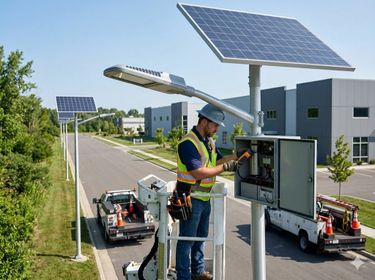
Lifecycle Maintenance Strategy for Solar Street Lights
Municipalities, commercial facilities, and industrial parks are increasingly adopting off-grid illumination to meet sustainability targets and reduce grid dependency. However, the true financial and operational value of these investments is determined long after the initial installation. Implementing a proactive solar street light maintenance protocol is the only definitive way to maximize your return on investment and ensure continuous, reliable performance throughout the year. A reactive, run-to-failure approach inevitably leads to unexpected downtimes, safety hazards, and inflated operational expenditures. This comprehensive guide details the essential strategies for facility managers, municipal project engineers, and general contractors to optimize the total cost of ownership across the entire standalone lighting system.
Understanding the Complete Solar Lighting Lifecycle
Every autonomous outdoor lighting fixture operates as an independent microgrid, relying on the precise, daily synchronization of solar arrays, energy storage, intelligent controllers, and high-efficiency LED modules. To accurately project capital expenditure and maintenance budgets, project engineers must first map the complete solar lighting lifecycle. While premium LED chips and rugged die-cast aluminum housings—such as those engineered by Infralumin—routinely exceed 50,000 to 100,000 hours of operational life, the power generation and chemical storage components degrade at significantly different rates based on localized thermal conditions and daily charge cycling.
The intelligent controller acts as the central nervous system, managing the electrical load, regulating power draw, and protecting the internal battery from deep discharges during prolonged periods of overcast weather. Recognizing that these individual subsystems age asynchronously is the crucial first step in transitioning from a reactive break-fix model to a predictive maintenance framework. Understanding this operational lifecycle allows project engineers to budget accurately for component end-of-life replacements, rather than prematurely replacing entire fixture heads, thereby preserving capital.
Solar Street Light Battery Replacement Planning
Energy storage remains the most critical point of potential failure in standalone lighting systems. Properly forecasting battery degradation prevents sudden municipal lighting blackouts and costly emergency dispatches. Different battery chemistries dictate entirely different maintenance timelines and operational expectations.
| Battery Chemistry | Average Lifespan | Depth of Discharge (DoD) | Temperature Resilience | Maintenance Requirement |
| LiFePO4 (Lithium Iron Phosphate) | 5 to 8 Years | 80% - 90% | Excellent | Very Low |
| Ternary Lithium | 3 to 5 Years | 70% - 80% | Moderate | Low |
| Gel / Lead-Acid | 2 to 4 Years | 50% | Poor to Moderate | Moderate to High |
To execute an effective replacement strategy and avoid dark zones, facility operators should monitor the following parameters:
- Charge Acceptance Rate:Monitor the time it takes for the battery to reach full capacity during peak sun hours. A noticeable increase in charge time often indicates internal resistance buildup within the battery cells.
- Voltage Drop Scrutiny:Record voltage levels immediately after sunset and right before dawn. Rapid, unpredictable voltage drops suggest compromised cell integrity and signal the need for an impending replacement.
- Physical Terminal Inspection:Annually check all battery terminals and wiring harnesses for oxidation and corrosion, especially in high-humidity or highly corrosive coastal installations.
- Thermal Environment Logging:Extreme heat significantly accelerates lithium degradation. Ensure the battery enclosure maintains adequate thermal management, ideally through an integrated, heat-dissipating housing that naturally draws heat away from sensitive electronics.
Panel Cleaning Schedules in Solar Lighting O&M
Photovoltaic efficiency dictates the charging capacity of the entire luminaire. Even minor shading from localized particulate matter, dust, or biological debris can drastically reduce the energy yield, leaving the battery starved for power. Structuring standard solar lighting O&M (Operations and Maintenance) procedures must prioritize photovoltaic panel clarity to ensure peak electrical generation.
A baseline cleaning schedule should closely adapt to local environmental factors rather than relying on a generalized timeline:
Arid and Desert Regions:High dust accumulation and sandstorms require bi-monthly dry brushing or compressed air cleaning. Leaving dust to settle combined with morning dew can result in hard caking that blocks sunlight.
Industrial Zones:Particulate matter, factory emissions, and exhaust fumes create sticky, oily residues on the glass. Bi-annual wet cleaning with non-abrasive, deionized water and mild detergents is necessary to dissolve chemical buildup without scratching the tempered glass surface.
Coastal Environments: Sea spray leaves a hazy, corrosive salt film that impedes light transmission. Quarterly freshwater rinsing is strictly required to maintain both panel efficiency and the integrity of the die-cast aluminum housing's anti-corrosion coating.
Avian Intersections:Bird droppings are highly acidic and create localized "hot spots" on the solar panel, which can permanently damage the cells. Areas with high bird populations require frequent spot-cleaning to prevent irreversible hardware damage.
Intelligent Monitoring and Off-Grid Lighting Service
Modern commercial and industrial installations are rapidly migrating away from manual, labor-intensive physical inspections toward remote, automated diagnostics. Integrating IoT sensors and intelligent wireless controllers (utilizing Zigbee, LoRaWAN, or cellular networks) into the street lights transforms a traditional off-grid lighting service into a proactive, data-driven operation. These intelligent systems seamlessly transmit real-time telemetry on photovoltaic voltage generation, battery temperature, and LED driver performance directly to a centralized cloud dashboard.
When a specific pole experiences a charging anomaly, a sudden drop in luminous efficacy, or a communication failure, the system instantly generates an automated alert, dispatching maintenance crews only when and where they are truly necessary. This precise targeting eliminates the need for routine, expensive truck rolls just to verify the status of healthy fixtures, significantly driving down operational overhead while ensuring strict municipal compliance with safety lighting standards. Furthermore, these remote systems allow operators to manually or automatically adjust dimming schedules, actively extending battery life during extended periods of inclement weather by temporarily reducing the fixture's lumen output.
Long-Term Maintenance Cost Control for Solar Street Lights
Ultimately, the primary objective for project managers is to aggressively lower the total cost of ownership over a 10- to 15-year operational horizon. While localized operational tactics are vital, true cost control begins much earlier, at the procurement phase. Partnering with a highly experienced solar street light factory that integrates structural reliability and ease of serviceability into the original product design heavily mitigates downstream labor and material expenses.
Key strategies for stabilizing long-term budgets and simplifying field operations include:
- Specify Tool-Free Maintenance Designs:Selecting advanced fixtures with snap-lock clips and modular internal components drastically reduces on-site labor hours. Field technicians can safely swap a degraded battery or a faulty LED driver in minutes while standing on a bucket truck, without requiring specialized tools or complex rewiring.
- Demand High IP/IK Ratings:Opting for IP66-rated enclosures and IK08+ impact resistance ensures internal electronic components remain perfectly isolated from moisture ingress, heavy dust, and physical vandalism, drastically reducing premature system failures.
- Standardize Component Sourcing:Utilizing identical intelligent controllers, LED optics, and battery form factors across a massive municipal deployment minimizes the spare parts inventory required for rapid deployment and repairs.
- Implement Warranty Tracking:Rigorously log installation dates, commissioning data, and manufacturer warranties. Reputable manufacturers provide substantial coverage on LED modules, die-cast housings, and primary electronics, absorbing costs that would otherwise negatively impact the facility budget.
Conclusion
Effective solar street light maintenance is not a reactive necessity; it is a calculated, strategic asset management process. By thoroughly understanding component lifecycles, executing precise battery replacement and panel cleaning protocols, and utilizing intelligent remote monitoring technology, facility managers can guarantee high-performance, specification-grade illumination year-round. Investing in high-quality, easily serviceable fixtures upfront remains the most financially impactful decision a commercial buyer or municipality can make. Through systematic maintenance and robust engineering design, entities can fully realize the financial, operational, and environmental benefits of off-grid infrastructure.
FAQs on Solar Lighting Management
How often should I schedule a complete inspection of my solar street lighting system?
For optimal performance and safety, a comprehensive physical and electrical inspection should be conducted bi-annually. This detailed audit includes checking battery terminals for corrosion, testing the response of the intelligent charge controller, verifying the structural integrity of the pole, and ensuring the die-cast aluminum housing remains securely sealed against the elements.
Will high-pressure washing damage the solar panels during routine cleaning?
Yes, high-pressure washing can aggressively degrade the protective seals around the photovoltaic tempered glass and force water into the electrical housing, causing catastrophic short circuits. Maintenance crews should always use low-pressure hoses, soft-bristled brushes, and mild, non-abrasive detergents to safely clear accumulated debris.
What happens if the solar street light battery is not replaced when it begins to degrade?
Failing to replace a degraded battery directly leads to heavily shortened illumination times, leaving areas dark well before dawn, especially during demanding winter months. Eventually, the battery will suffer a deep discharge failure, which can create electrical strain and potentially damage the intelligent charge controller, turning a simple battery swap into a costly multi-component repair.
Can I upgrade the battery capacity of an existing solar street light to get more hours of light?
It depends entirely on the original manufacturer's design tolerances. While upgrading to a higher-capacity LiFePO4 battery is occasionally possible, the integrated solar panel must possess sufficient wattage to fully charge the larger battery during limited daylight hours. Additionally, the fixture's internal housing must physically accommodate the larger dimensions of the new battery without compromising heat dissipation.
Why is my solar street light blinking or flashing in the middle of the night?
Blinking is a deliberate indicator of a low-voltage disconnect, triggered by the fixture's intelligent controller. It signals that the internal battery lacks sufficient charge to sustain the LED load, prompting the system to shut down and attempt restarts. Proper solar street light maintenance dictates that you should immediately check the photovoltaic panel for severe shading or dirt accumulation, and physically test the battery's health to ensure it can still hold a charge.

Zhongshan Lumin Technology Co., Ltd. is a renowned high-tech enterprise specializing in the research, development, and manufacturing of industrial LED lights.
Contact
@2026 Zhongshan Lumin Technology Co., Ltd.