

How EPC Contractors Price Solar Street Lighting Projects
When municipalities, industrial parks, or private developers issue tenders for off-grid infrastructure, the financial modeling behind a solar street lighting EPC (Engineering, Procurement, and Construction) bid dictates both the project's viability and the contractor's profit margins. Unlike traditional grid-tied systems where upfront hardware costs are lower but long-term energy bills are continuous, off-grid solutions front-load the capital expenditure. For procurement officers and facility managers, analyzing how a contractor structures these bids is critical to avoiding subpar installations that fail after their first harsh winter. This guide demystifies the precise methodologies contractors use to calculate project estimates, breaking down hardware variables, site-specific labor conditions, and the invisible risk buffers that safeguard multi-year warranties.
BOM Cost Structure in Solar Street Lighting EPC Projects
The Bill of Materials (BOM) remains the heaviest financial anchor in any off-grid infrastructure deployment, typically accounting for the vast majority of the total upfront capital. To understand the granular solar lighting project cost, contractors divide the hardware into five distinct technical pillars. The luminaire itself, comprising the high-efficacy LED chips, precision optical lenses, and the heat dissipation housing, usually represents about twenty to twenty-five percent of the hardware expense. High-end manufacturers like Infralumin utilize heavy-duty die-cast aluminum enclosures with superior IP/IK ratings and tool-less maintenance designs. While this premium construction slightly shifts the initial cost ratio, it drastically reduces future maintenance liabilities. The energy storage unit, overwhelmingly transitioning to high-cycle LiFePO4 (Lithium Iron Phosphate) battery packs due to their thermal stability, commands the largest share, absorbing roughly thirty-five to forty percent of the BOM. Solar panels, whether high-efficiency monocrystalline or standard polycrystalline, account for another fifteen percent. The remaining twenty percent is split between intelligent charge controllers—specifically MPPT (Maximum Power Point Tracking) units that optimize energy harvest—and the physical mounting hardware, including galvanized steel poles.
According to recent off-grid solar market trend data published in the GOGLA annual report, the hardware cost range for institutional-grade lighting projects has stabilized, yet quality disparities remain vast. EPC contractors sourcing Tier 1 components consistently submit baseline BOM costs that reflect these rigorous standards. Rather than selecting the cheapest available diodes or using recycled battery cells, reputable EPC solar lighting firms leverage established supply chain partnerships to secure OEM/ODM pricing on premium components. They calculate the lumen-per-watt efficacy and the battery depth of discharge (DoD) to ensure the system operates flawlessly through the required autonomy days. This meticulous hardware selection balances the initial component expenditure against the strict performance penalties outlined in municipal public works contracts.
Installation and Labor Cost for Solar Street Lights
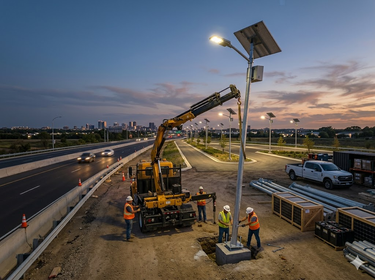
While the hardware establishes the performance baseline, the physical deployment dictates the operational timeline and labor overhead. The installation phase for commercial solar lighting requires precise orchestration of heavy machinery, specialized electrical crews, and civil engineering teams. Based on recent data extracted from the TED (Tenders Electronic Daily) European procurement database, municipal solar street light tender unit prices reveal that labor and deployment logistics can constitute 20% to 35% of the total contract value. This fluctuates heavily based on geographical terrain and local labor union rates. Contractors calculate these expenses by evaluating several critical on-site phases:
- Site Preparation and Civil Works:Before any pole is erected, contractors must price the excavation of foundation pits, the pouring of reinforced concrete footings, and the precise setting of anchor bolts. Soil composition heavily influences this line item; rocky terrain, high water tables, or coastal sand requires specialized drilling equipment and customized foundation engineering, driving up civil work costs.
- Assembly and Hoisting Operations:Off-grid systems save on underground trenching and copper cabling, but they require complex mechanical assembly. Crews must attach the solar panels at optimal azimuth angles, secure heavy battery enclosures safely, and utilize crane trucks to hoist 6-meter to 12-meter poles into perfect vertical alignment.
- System Commissioning and Calibration:Once physically installed, technicians must configure the MPPT controllers and set the programmable dimming profiles (e.g., operating at 100% output during peak evening hours, then automatically dropping to 30% after midnight to conserve battery). If smart lighting options are included, units must be integrated into centralized management software via Zigbee or LoRaWAN networks.
- Traffic Management and Logistics:For roadway infrastructure projects, contractors must factor in the cost of temporary lane closures, safety flaggers, and strict compliance with local Department of Transportation safety regulations, adding a daily burn rate to the labor budget.
Risk and Warranty Buffer in Solar Lighting Pricing
Beyond the tangible hardware and labor, an EPC contractor must financially insulate the project against long-term liabilities through a calculated risk and warranty buffer. When analyzing public winning bid prices within the World Bank procurement database for infrastructure upgrades in developing regions, there is a clear margin variance between standard product supply and full turnkey delivery. This margin divergence represents the risk premium. Off-grid systems operate in unforgiving environments, facing fluctuating temperature extremes, high wind loads, corrosive salt spray, and potential vandalism. Contractors must guarantee the system's operational uptime, often mandated at 99% reliability, across a five to ten-year warranty period.
To sustain this guarantee, the financial model incorporates a contingency fund, typically ranging from 10% to 15% of the total project value. This buffer absorbs the costs of potential component failures, the logistical expenses of dispatching maintenance crews to remote locations, and the eventual replacement of components like batteries that naturally degrade over thousands of charge cycles. Furthermore, contractors dealing with cross-border supply chains factor in currency exchange volatility, import tariffs, and ocean freight shipping fluctuations. By embedding these risk variables directly into the unit pricing, the contractor ensures they can honor long-term service level agreements without compromising the project's overall profitability or the client's lighting infrastructure reliability.
EPC Quotation Structure & 500-Light Project Estimation
To transition from theoretical pricing to practical application, we can examine a standard EPC quotation structure. A professional bid categorizes expenses into three main layers: the core BOM, deployment execution, and the profit/risk margin.
Below is a simulated cost range estimation for a typical 500-light municipal roadway project.
(Assumptions: 8-meter galvanized poles, 60W LED luminaires featuring die-cast aluminum with IK08/IP66 ratings, 120W monocrystalline panels, 60AH LiFePO4 batteries, standard soil conditions, and a 5-year comprehensive warranty).
| Cost Category | Description | Est. Cost per Unit (USD) | Total Cost for 500 Units (USD) | % of Total EPC Bid |
| Hardware (BOM) | Luminaire, panel, battery, MPPT, pole, brackets. | $450 - $650 | $225,000 - $325,000 | 55% - 60% |
| Civil & Labor | Foundation pouring, assembly, crane hoisting, commissioning. | $150 - $250 | $75,000 - $125,000 | 20% - 25% |
| Logistics & Freight | Ocean freight, inland transport, site storage. | $40 - $60 | $20,000 - $30,000 | 5% - 7% |
| Risk Buffer & Margin | Warranty reserve, currency contingency, profit. | $80 - $120 | $40,000 - $60,000 | 10% - 15% |
| Total Estimated | Complete turnkey project delivery. | $760 - $1,080 | $380,000 - $540,000 | 100% |
Before a procurement officer signs off on a final contract, vetting the quotation for hidden omissions is vital. Use the following Quotation Verification Checklist to ensure the contractor has provided a transparent and comprehensive bid:
- Battery Chemistry & Cycle Life:Does the quote explicitly state LiFePO4 with a minimum of 2000 cycles at 80% DoD, or is it a vague "lithium battery" line item?
- Autonomy Days Defined:Is the system mathematically guaranteed to operate for 3 to 5 continuous rainy/cloudy days based on your local solar irradiance data?
- Foundation Specs Included:Are the dimensions and concrete grade for the pole footings clearly defined in the civil works section?
- Wind Load Resistance:Has the pole and panel bracket system been certified to withstand local maximum wind speeds (e.g., hurricane or typhoon zones)?
- Warranty Terms Isolated:Are the warranties for the battery, LED chip, and solar panel broken down individually, and do they cover both parts and replacement labor?
- Smart Control Licensing:If integrating a smart lighting management system, are the first 3-5 years of software licensing and network data fees included in the upfront price?
Conclusion
Mastering the cost mechanics behind a solar street lighting EPC contract empowers buyers to make data-driven infrastructure decisions. By understanding the distinct line items—from the hardware BOM allocation and civil engineering labor to the hidden risk buffers—municipalities and developers can identify bids that offer genuine long-term value rather than just a deceptively low initial price. As an experienced manufacturer of high-performance outdoor LED solutions, Infralumin partners directly with global contractors, providing OEM/ODM customization, stringent quality control, and engineering support to ensure your next off-grid lighting project is financially sound and technically flawless.
Frequently Asked Questions
What is the most expensive component in a solar street lighting EPC project?
The energy storage system, typically utilizing high-cycle LiFePO4 battery packs, is the most expensive component, accounting for 35% to 40% of the total hardware Bill of Materials (BOM).
How do contractors calculate labor costs for off-grid solar lighting?
Contractors calculate labor based on site preparation, concrete foundation pouring, pole assembly, crane hoisting, and system commissioning. Labor usually represents 20% to 35% of the total project cost, depending on local union rates and terrain difficulty.
Why do EPC solar lighting bids include a risk and warranty buffer?
Because off-grid systems face harsh environmental conditions, contractors add a 10% to 15% contingency margin. This buffer covers potential long-term maintenance, battery replacements under warranty, and operational uptime guarantees mandated by the client.
What is the average lifespan of a commercial solar lighting system?
High-quality commercial solar lighting systems feature LED luminaires and solar panels designed to last 15 to 25 years. However, the LiFePO4 batteries typically require replacement every 5 to 8 years, depending on the depth of discharge and climate.
How can I verify if an EPC contractor's lighting quote is accurate?
Always request a detailed BOM breakdown. Ensure the quote explicitly details battery chemistry, guaranteed autonomy days, wind load certifications for the poles, and separates hardware costs from installation labor and smart software licensing fees.

Zhongshan Lumin Technology Co., Ltd. is a renowned high-tech enterprise specializing in the research, development, and manufacturing of industrial LED lights.
Contact
@2026 Zhongshan Lumin Technology Co., Ltd.