

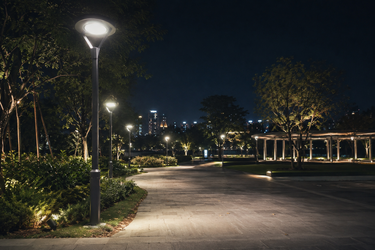
How to Select Vandal-Resistant LED Post Lights for Public Parks and Plazas
Public parks and plazas are designed to be welcoming spaces, but the lighting installed in these areas faces challenges that aren't always obvious during the planning stage. Fixtures may be exposed to accidental impacts, deliberate vandalism, harsh weather, and years of continuous operation. Choosing the right vandal-resistant outdoor lighting isn't simply about installing brighter fixtures—it means selecting products that can withstand real-world conditions while keeping maintenance costs under control.
For municipalities, contractors, and landscape architects, durability has become just as important as lighting performance. From impact-resistant materials to tamper-proof hardware, every design detail affects the long-term reliability of a lighting system. So, what should you look for when specifying LED post lights for public spaces?
Why IK Rating Is Crucial for Public Outdoor Lighting
When evaluating outdoor lighting products, many buyers focus on IP ratings because they indicate protection against dust and water. However, for parks, plazas, pedestrian streets, and recreational areas, the IK rating deserves just as much attention.
The IK rating measures how well a luminaire withstands mechanical impact. In public environments where accidental collisions, vandalism, or maintenance equipment may strike the fixture, impact resistance directly influences product lifespan.
The table below shows common IK protection levels.
| IK Rating | Impact Energy | Typical Application |
|---|---|---|
| IK07 | 2 Joules | Residential pathways |
| IK08 | 5 Joules | Commercial landscapes |
| IK09 | 10 Joules | Urban public spaces |
| IK10 | 20 Joules | Parks, plazas, transport hubs |
For projects requiring reliable vandal-resistant outdoor lighting, IK10 is widely regarded as the preferred specification. Fixtures with this level of protection are better equipped to withstand repeated impacts without compromising structural performance.
When specifying IK10 post lights, engineers should also evaluate several related factors rather than relying solely on the rating itself:
- Housing thickness and structural reinforcement
- Lens material and impact resistance
- Mounting stability under repeated vibration
- Fastener quality and corrosion resistance
- Overall product certification and testing standards
A high IK rating delivers the greatest value when combined with a durable housing, quality components, and a well-engineered mechanical structure.
Modern public park lighting projects increasingly prioritize long service life over the lowest purchase price. A more robust fixture may cost slightly more initially, but it can significantly reduce replacement frequency and maintenance expenses throughout the project's lifecycle.
Polycarbonate vs. Tempered Glass Diffusers for Impact Resistance
The diffuser is one of the most vulnerable parts of any outdoor luminaire. It protects the LED module while shaping light distribution, yet it must also withstand years of environmental exposure and occasional impacts.
The two most common diffuser materials are polycarbonate and tempered glass, each offering different advantages.
| Feature | Polycarbonate | Tempered Glass |
|---|---|---|
| Impact Resistance | Excellent | Good |
| Breakage Risk | Very Low | Higher under severe impact |
| Weight | Lightweight | Heavier |
| UV Stability | High-quality grades perform well | Excellent |
| Optical Clarity | Very Good | Excellent |
| Best Application | High-vandalism public areas | Decorative or architectural lighting |
For installations where vandalism is a realistic concern, polycarbonate often provides the better balance between durability and safety. Instead of shattering, it absorbs impact energy more effectively, reducing the likelihood of damage after accidental collisions or deliberate abuse.
Tempered glass remains a strong option for many commercial applications because of its excellent transparency and scratch resistance. However, in parks, playgrounds, transit stations, and busy plazas, impact resistance generally takes priority over appearance.
Material selection should also consider environmental conditions. Areas exposed to frequent temperature changes, heavy pedestrian traffic, or maintenance equipment benefit from components designed to resist repeated mechanical stress over many years.
High-quality commercial LED post lights often combine UV-stabilized polycarbonate diffusers with precision optical lenses. This configuration maintains lighting efficiency while providing better protection for the internal LED system.
Beyond durability, diffuser design also influences visual comfort. Well-engineered optics help reduce glare, improve light distribution, and create a more pleasant nighttime environment for pedestrians without sacrificing efficiency.
Die-Cast Aluminum Housing for Structural Integrity
While the diffuser is the most exposed component, the housing serves as the backbone of the entire luminaire. A weak enclosure can shorten the service life of even the highest-quality LED components.
For this reason, die-cast aluminum has become the preferred material for premium outdoor lighting applications. Compared with stamped steel or plastic housings, it offers greater mechanical strength while remaining relatively lightweight. More importantly, it maintains its structural stability after years of exposure to rain, UV radiation, temperature fluctuations, and corrosive outdoor environments.
In demanding public park lighting projects, a die-cast aluminum housing provides several practical advantages:
- High resistance to impact and deformation
- Excellent heat dissipation for longer LED lifespan
- Better corrosion resistance with outdoor-grade powder coating
- Stable performance under changing weather conditions
- Lower long-term maintenance requirements
Heat management is another reason why die-cast aluminum is widely used. LEDs generate less heat than traditional light sources, but excessive junction temperature can still reduce lumen output and shorten driver life. Aluminum efficiently transfers heat away from the LED module, helping maintain consistent lighting performance throughout the fixture's operating life.
Structural design also plays a significant role. Reinforced ribs, thicker mounting sections, and integrated support brackets allow the luminaire to withstand wind loads and repeated vibration without loosening over time. These details become especially important for installations in open plazas, waterfronts, or pedestrian streets where environmental stress is greater.
For municipalities and contractors, selecting a durable housing is not simply about preventing damage—it is about reducing maintenance visits, minimizing replacement costs, and ensuring dependable operation for years after installation.
Tamper-Proof Screws and Anti-Theft Designs in Commercial Post Lights
Mechanical strength alone cannot prevent vandalism. In many public spaces, fixtures are intentionally opened, dismantled, or damaged, making security features just as important as structural durability.
Modern commercial LED post lights are increasingly designed with anti-tamper features that discourage unauthorized access while simplifying routine maintenance for authorized personnel.
Common protective features include:
- Tamper-proof security screws that require specialized tools
- Hidden fastening systems to reduce exposed hardware
- Locking brackets that secure the luminaire to the pole
- Internal cable routing to prevent cable theft or accidental damage
- Reinforced access covers that resist forced opening
These seemingly small design improvements can significantly reduce maintenance incidents in parks, campuses, transportation hubs, and commercial developments.
Another consideration is the connection between the luminaire and the pole. A robust mounting interface distributes mechanical loads more evenly, reducing the risk of loosening caused by vibration or repeated impacts. Poorly designed mounting systems may allow slight movement over time, eventually affecting alignment and overall structural stability.
For projects installed along pedestrian walkways or light post street applications, anti-theft protection is equally valuable. Drivers, electrical components, and internal wiring are often targeted because they can be removed quickly if the fixture lacks adequate security measures.
Today's premium post top lights are therefore engineered with both durability and maintenance efficiency in mind. Tool-free access for authorized servicing can coexist with anti-tamper hardware, allowing maintenance teams to perform inspections efficiently while preventing unauthorized disassembly.
When these security features are combined with an IK10-rated housing, high-quality optics, and corrosion-resistant materials, the result is a lighting system capable of delivering reliable performance in demanding public environments for many years.
Choosing the Right LED Post Light for Long-Term Value
Selecting a vandal-resistant luminaire involves more than checking a specification sheet. A successful project balances durability, lighting performance, maintenance efficiency, and total lifecycle cost.
Before making a final product selection, it is worth confirming whether the fixture offers:
- An IK10 impact rating for high-risk public environments
- A die-cast aluminum housing with effective thermal management
- UV-resistant polycarbonate or other impact-resistant diffuser materials
- Tamper-proof hardware and secure mounting systems
- Appropriate IP protection for local weather conditions
- Reliable optical performance with uniform light distribution
Looking at these factors together provides a more complete picture of how the fixture will perform after years of continuous outdoor service, rather than simply comparing initial purchase prices.
Conclusion
Public lighting projects are long-term investments, and durability should never be treated as an afterthought. Choosing vandal-resistant outdoor lighting with the right combination of IK protection, durable materials, secure mechanical design, and reliable optical performance helps reduce maintenance costs while improving safety and user experience.
Whether you're specifying lighting for a city park, pedestrian plaza, university campus, or commercial landscape, selecting high-quality fixtures from the beginning can deliver measurable value throughout the entire lifecycle of the project.
At Infralumin, we manufacture commercial-grade LED outdoor lighting solutions designed for demanding public environments. Our portfolio of commercial LED post lights combines die-cast aluminum construction, high IK/IP protection, precision optics, and OEM/ODM customization to help municipalities, contractors, and distributors build lighting systems that last.
FAQ
What makes vandal-resistant outdoor lighting different from standard outdoor fixtures?
Vandal-resistant outdoor lighting is designed with stronger housings, impact-resistant materials, and anti-tamper features to withstand intentional damage and harsh public environments.
Why are IK10 post lights recommended for public parks?
IK10 post lights can withstand impacts of up to 20 joules, making them well suited for public park lighting where accidental collisions and vandalism are more likely.
Are polycarbonate diffusers better than tempered glass?
For high-risk public areas, polycarbonate generally offers better impact resistance. Tempered glass provides excellent optical clarity but may be less suitable where vandalism is a concern.
What features should I look for in commercial LED post lights?
Look for a die-cast aluminum housing, high IK and IP ratings, quality optical performance, corrosion-resistant finishes, and tamper-proof hardware.
Can post top lights be used in both parks and commercial plazas?
Yes. Modern post top lights are widely used in parks, plazas, campuses, residential communities, and pedestrian streets because they provide uniform illumination while complementing the surrounding landscape.
How do light post street fixtures reduce maintenance costs?
A well-designed light post street fixture combines durable materials, efficient thermal management, and secure construction, helping reduce repairs and extend service life.

Zhongshan Lumin Technology Co., Ltd. is a renowned high-tech enterprise specializing in the research, development, and manufacturing of industrial LED lights.
Contact
@2026 Zhongshan Lumin Technology Co., Ltd.