

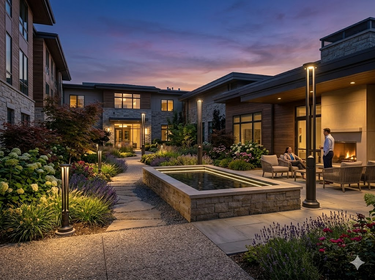
How Many LED Post Lights Do I Need for My Courtyard?
Designing the lighting for a commercial, industrial, or municipal courtyard is a complex undertaking that requires far more than simply selecting an attractive fixture. It is a critical component of public safety, site security, and overall architectural aesthetics. Whether you are a specialized lighting designer mapping out a new municipal park, an engineering consultant for an industrial complex, or a general contractor updating a corporate campus, you will inevitably face the same critical question: how many post lights do I need to achieve the perfect balance of illumination?
Striking this balance ensures you avoid harsh glares from over-lighting or unsafe, shadowed patches from under-lighting. To get this right, professionals must look beyond basic wattage and dig into the technical side of optical distribution, physical area dimensions, and precise target light levels. Ready to master the technical framework and calculate the exact lighting requirements for your next outdoor project? Let us break down the engineering principles step by step.
Assessing Courtyard Dimensions
Before diving into specific fixture specifications or optical data, you must define the physical canvas of your project. Accurate site measurements prevent costly over-purchasing and eliminate the risk of inadequate coverage. Start by thoroughly mapping out the physical landscape of the commercial or industrial courtyard.
- Calculate Total Square Footage: Measure the maximum length and width of the target area. Multiply these figures to find the total square footage (or square meters). This fundamental baseline number is the absolute foundation of any accurate lighting plan.
- Identify Obstacles and Architectural Features: Carefully note the locations of mature trees, architectural columns, water features, or outdoor seating areas on your site plan. These elements act as physical barriers that cast shadows and will dictate necessary adjustments to your fixture placement.
- Determine Pedestrian Flow: High-traffic walkways and building entrances demand significantly higher visibility standards compared to quiet, decorative perimeter gardens. Map out where foot traffic is heavily concentrated to prioritize illumination zones.
- Account for Ambient Light: Evaluate existing light from nearby municipal streetlights, building wall packs, or illuminated commercial signage. Integrating these ambient sources into your plan prevents redundant lighting and reduces unnecessary energy consumption.
Understanding Lumens and Lux
Transitioning from physical site dimensions to concrete lighting metrics requires a solid grasp of how professional lighting engineers quantify illumination. In the commercial outdoor lighting sector, the two most critical metrics you will encounter are lumens and lux. Put simply, post light lumens measure the absolute total amount of visible light emitted directly from the LED source. However, an exceptionally high-lumen output alone does not guarantee a well-lit courtyard if that light is poorly distributed through an inefficient lens.
This is where the concept of lux becomes indispensable for contractors and designers. Lux represents the actual intensity of light that successfully reaches the ground or a targeted surface, with one lux equating to one lumen per square meter. When consulting with municipal planners or landscape architects, the project target is usually strictly defined in lux or foot-candles, depending on specific regional compliance standards. A standard commercial courtyard generally requires between 10 to 20 lux for basic visibility and pedestrian safety, while high-activity zones or security-sensitive industrial campuses might necessitate up to 50 lux. Understanding the direct relationship between the raw output of the LED chip and the delivered illuminance hitting the pavement allows you to choose fixtures equipped with the correct optical lenses. This guarantees that every single lumen is utilized efficiently, minimizing light pollution and maximizing visual comfort.
Calculating the Number of Post Lights
With your dimensional data and target lux formally established, you can move directly into the courtyard lighting calculation. The mathematical formula utilized by lighting engineers to establish a project baseline is highly systematic: Total Lumens Required equals the Target Lux multiplied by the Total Area in square meters. For example, if you are illuminating a 2,000-square-meter commercial plaza and require an average of 15 lux, your total required output is 30,000 lumens. Once you have this aggregate figure, you simply divide it by the delivered lumen output of your selected luminaire. If you choose a premium fixture delivering 5,000 lumens, the baseline calculation suggests you need six fixtures.
However, real-world commercial applications demand a more nuanced approach by factoring in the Light Loss Factor (LLF). Even the most advanced LED chips and LED drivers experience minor degradation over an extended operational lifespan, and harsh outdoor environments inevitably introduce dirt and debris onto the optical lens. By multiplying your final fixture count by a standard LLF of 0.8 to 0.85, you build a necessary engineering buffer into your layout. In the previous example, adjusting for an LLF of 0.8 would increase your requirement to roughly seven or eight fixtures. This ensures the courtyard remains safely and fully illuminated years after the initial installation. By adhering strictly to this systematic formula, you optimize both the initial capital expenditure of the project and the long-term energy consumption of the facility.
Ideal Spacing for Post Lights
Calculating the total number of fixtures provides your inventory requirements, but placing them correctly on the site plan is what dictates the final visual quality. Proper LED post light spacing eliminates intense hot spots and dangerous dark zones, providing a uniform, seamless blanket of light across the property.
- The Height-to-Spacing Ratio: As a reliable rule of thumb within the commercial lighting industry, the spacing between fixtures should be roughly 2.5 to 3 times the height of the mounting pole. For instance, if you are mounting a luminaire on a 12-foot pole, the ideal spacing will generally sit somewhere between 30 and 36 feet apart.
- Optical Distribution Types: The specific light distribution pattern—such as Type III, IV, or V optics—dramatically affects your spacing strategy. A Type V distribution throws light in a wide, symmetrical 360-degree circle, allowing for significantly wider spacing in open plazas. Conversely, Type III optics push light forward and to the sides, making it the superior choice for perimeter pathways.
- Safety Overlap and Uniformity: Always ensure there is a calculated overlap in the light pools on the ground. This overlap is crucial for maintaining a strong uniformity ratio, which eliminates shadowing, aids in facial recognition for security cameras, and enhances overall pedestrian safety.
Selecting Height and Design
When outfitting a demanding commercial, industrial, or public municipal courtyard, the physical design and technical durability of the luminaire are just as critical as the photometric data. High-quality outdoor solutions must be engineered specifically for longevity in uncompromising environments.
Project managers must prioritize fixtures constructed with rugged die-cast aluminum housings to withstand severe weather fluctuations. Furthermore, verifying high protection ratings—specifically IP66 for total defense against water and dust ingress, and IK09 for robust impact resistance—ensures the luminaire survives both heavy storms and potential vandalism in public spaces.
Selecting the appropriate pole height depends entirely on the specific application and scale of the courtyard. Below is a professional comparative guide to help match mounting height to your specific project application:
| Pole Height | Ideal Application Scenario | Characteristics & Engineering Advantages |
|---|---|---|
| 8 to 10 feet | Decorative garden beds, tight pedestrian walkways | Provides intimate, low-glare lighting; excellent for areas where human scale and ambiance are priorities. |
| 12 to 15 feet | Standard commercial courtyards, municipal parks | Balances wide optical coverage with pedestrian comfort; the standard for most mid-sized outdoor projects. |
| 16 to 20+ feet | Large open public plazas, industrial campus exteriors | Maximizes photometric coverage area; significantly reduces the total number of fixtures required on site. |
Beyond physical dimensions and durability, modern installations benefit immensely from advanced features. Opting for luminaires with adjustable color temperature (CCT) provides on-site flexibility, while integrating smart lighting options—such as motion sensors or central control systems—drastically cuts energy costs. Additionally, selecting fixtures with a tool-free maintenance design saves municipal maintenance teams and contractors significant labor hours during routine upkeep. Leveraging OEM/ODM customization services also guarantees that the final product aligns perfectly with the architectural vision of the site.
Conclusion
Engineering an effective and compliant outdoor lighting layout requires technical precision, from the initial courtyard lighting calculation to selecting the optimal fixture height and optical lens. By meticulously assessing your site dimensions, understanding the necessary post light lumens, and calculating the exact LED post light spacing, you can deliver a safe, efficient, and visually striking environment. You no longer have to guess how many post lights do I need; armed with these engineering principles, you possess the technical framework to execute any commercial lighting project flawlessly.
Infralumin – Illuminating the Future with Precision, Durability, and Smart Outdoor Solutions.
FAQ
What is the standard lumen output for commercial courtyard fixtures?
Generally, commercial post light lumens range from 3,000 to 8,000 lumens per fixture. The exact requirement depends heavily on the mounting height of the pole and the target lux levels dictated by the specific application area or municipal code.
How does pole height directly affect LED post light spacing?
Taller mounting poles cast a significantly wider pool of illumination, allowing engineers to increase the LED post light spacing. Conversely, shorter poles restrict the light spread, requiring closer spacing to prevent dangerous dark spots between the fixtures.
Can I rely on a basic courtyard lighting calculation for uneven terrains?
While a foundational courtyard lighting calculation provides an excellent project baseline, highly uneven terrains or complex landscapes require professional photometric software (like DIALux) to accurately account for elevation changes and potential physical shadowing.
How exactly do I know how many post lights do I need for a 1,000 square meter plaza?
If your target is 20 lux, your baseline requirement is 20,000 total delivered lumens. If you utilize 5,000-lumen fixtures, you need a base of 4 units. However, after factoring in an essential light loss multiplier for long-term degradation, 5 to 6 fixtures is the safer, professional recommendation.
Why are IP and IK ratings so critical for outdoor installations?
IP ratings dictate the fixture's defense against dust and water, which is non-negotiable for outdoor weather survival. IK ratings measure mechanical impact resistance, guaranteeing the luminaire can withstand vandalism, flying debris, or accidental impacts in heavily trafficked public spaces.

Zhongshan Lumin Technology Co., Ltd. is a renowned high-tech enterprise specializing in the research, development, and manufacturing of industrial LED lights.
Contact
@2026 Zhongshan Lumin Technology Co., Ltd.