

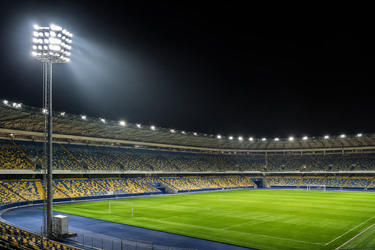
How Many Watts Do You Need for LED Stadium Lighting?
Installing stadium lighting isn't simply about choosing the most powerful fixture available. A lighting system that is too weak can leave dark spots and fail to meet sports standards, while an oversized system increases both equipment costs and energy consumption. That's why understanding LED Stadium Lighting Wattage is one of the first steps in planning any sports lighting project.
Modern LED technology has dramatically improved lighting efficiency, allowing stadiums to achieve higher brightness with lower power consumption than traditional metal halide systems. However, the ideal wattage depends on several factors, including the size of the venue, required illuminance, mounting height, and beam distribution. So, how many watts do you need for LED stadium lighting? Let's break it down by application.
How Many Watts Are Typically Needed for LED Stadium Lighting?
There is no universal wattage for every sports venue. The right LED stadium light wattage requirements depend on how the facility will be used and the lighting standards it must meet. In general, higher-level competitions require greater illuminance, better uniformity, and more precise optical control.
| Application | Typical Fixture Wattage | Typical Lux Level |
|---|---|---|
| Small Training Fields | 200W–500W | 100–300 lux |
| Amateur Sports Facilities | 500W–800W | 300–500 lux |
| Professional Stadiums | 800W–1500W+ | 750–2000 lux |
These figures are only starting points. A professional lighting simulation is always recommended before selecting fixtures for a commercial sports project.
Small Training Fields
Training grounds, school playgrounds, and community sports courts usually require moderate lighting rather than maximum brightness. Fixtures rated between 200W and 500W are often sufficient to provide safe visibility for recreational activities and daily practice.
At this level, designers focus on achieving even light distribution while keeping installation and operating costs low. High-efficiency LED fixtures with quality optics can easily outperform older HID systems while consuming significantly less energy.
Amateur Competition and Medium Sports Facilities
Municipal football fields, baseball parks, and university sports venues generally require 500W to 800W LED stadium lighting fixtures. These facilities host regular competitions, making lighting quality just as important as brightness.
The objective is to provide consistent illumination across the entire playing area while minimizing glare for athletes and spectators. Proper fixture placement and beam angle selection often improve lighting performance more effectively than simply increasing wattage.
Professional Stadiums and Broadcast-Level Facilities
Professional stadiums demand the highest lighting performance. International competitions and televised events typically require fixtures between 800W and 1500W or higher, depending on the field size and broadcasting standards.
At this level, lighting design involves more than selecting powerful fixtures. Engineers must carefully balance lumen output, optical distribution, uniformity, and glare control to deliver excellent visibility for players, officials, spectators, and high-definition cameras. A professional lighting simulation is essential to determine the most suitable fixture configuration.
What Factors Determine the Required LED Stadium Lighting Wattage?
If you're asking, "How many watts do I need for LED stadium lighting?", the answer depends on much more than fixture power alone. A successful lighting system combines the right wattage with thoughtful engineering to deliver the required brightness efficiently. Before selecting fixtures, several key factors should be evaluated.
Field Size and Layout
The larger the playing area, the greater the total light output required. However, field dimensions are only part of the equation. The number of lighting poles, their locations, and fixture spacing all influence how evenly light reaches the playing surface.
A well-planned layout can often reduce the number of fixtures needed while maintaining excellent lighting uniformity. This is why professional lighting calculations are recommended before purchasing equipment, especially for commercial and municipal projects.
Required Lux Level
Different sports and competition levels have different lighting standards. Recreational training may only require 100–200 lux, while amateur competitions typically need 300–500 lux. Professional matches and television broadcasts often require 1,000 lux or more. As the required lux level increases, the overall lumen output must also increase. Instead of relying solely on higher-wattage fixtures, designers often combine multiple fixtures with optimized optics to achieve the desired illumination while maintaining energy efficiency.
Mounting Height
Mounting Height
Pole height has a direct impact on lighting performance. Higher mounting positions provide wider coverage but reduce the light intensity reaching the ground. To compensate, projects with taller poles often require fixtures with higher lumen output or more focused optical systems.
Typical mounting heights include:
- 8–15 m for training facilities
- 15–25 m for community and municipal sports fields
- 25–40 m for professional stadiums
Selecting the appropriate wattage should always take mounting height into account rather than treating it as an independent factor.
Beam Angle and Light Distribution
Beam angle determines how light is distributed across the field. Even a high-power fixture can produce poor results if the beam angle does not match the installation height or field dimensions.
Choosing the correct optical lens helps to:
- Improve lighting uniformity
- Reduce glare for players and spectators
- Minimize light spill outside the venue
- Increase lighting efficiency without unnecessary power consumption
For this reason, professional LED stadium lighting systems focus on optical performance as much as fixture wattage.
Infralumin LED Stadium Lighting Solutions
At Infralumin, we understand that every sports venue has unique lighting requirements. Instead of offering a one-size-fits-all solution, we provide customized LED stadium lighting systems tailored to your project, helping you achieve the required illumination with maximum efficiency.
Our LED stadium lights are engineered for demanding outdoor environments and feature:
- High luminous efficacy of up to 200 lm/W for lower energy consumption
- Durable die-cast aluminum housing for excellent heat dissipation
- IP66 waterproof and IK08/IK10 impact protection
- Multiple beam angle options for different field layouts and pole heights
- Flicker-free drivers suitable for HD broadcasting
- Adjustable CCT and optional smart lighting controls
- Tool-free maintenance design to reduce servicing time
- OEM and ODM customization for distributors and project contractors
Beyond supplying products, our engineering team provides professional lighting design support, including Dialux simulations, fixture selection, and layout recommendations. By analyzing field dimensions, mounting height, and target lux levels, we help customers determine the most suitable LED stadium light wattage requirements while reducing long-term operating costs.
Whether you're upgrading an existing sports facility or planning a new stadium project, Infralumin delivers reliable, energy-efficient lighting solutions designed for long service life and outstanding performance.
Conclusion
Choosing the right LED Stadium Lighting Wattage isn't about installing the highest-power fixture—it's about designing a lighting system that matches your venue's size, competition level, and performance requirements. By considering factors such as field dimensions, target lux levels, mounting height, and beam angle, you can achieve excellent illumination while minimizing energy consumption and maintenance costs.
At Infralumin, we combine high-performance LED stadium lighting products with professional lighting design support to help distributors, contractors, and project owners build reliable, efficient sports lighting systems. If you're planning a new installation or upgrading an existing facility, our team is ready to help you find the right solution for your project.
FAQs
How many watts do I need for LED stadium lighting?
The answer depends on the venue size, required lux level, pole height, and competition standard. Most LED stadium lighting projects use fixtures ranging from 200W to 1500W.
What is the typical LED Stadium Lighting Wattage for a football field?
Community football fields commonly use 500W–800W fixtures, while professional stadiums often require 800W–1500W+ LED stadium lighting combined with a professional lighting layout.
Does higher wattage always mean brighter LED stadium lighting?
No. Higher wattage increases power consumption, but lighting performance also depends on luminous efficacy, beam angle, optical design, and fixture placement. An efficient system can deliver better results without using excessive wattage.
What factors affect LED stadium light wattage requirements?
The main factors include field size, required lux level, mounting height, beam angle, and lighting uniformity. These elements should be evaluated together to determine the appropriate LED stadium light wattage requirements.
Can LED stadium lighting reduce energy costs?
Yes. Compared with traditional metal halide systems, modern LED stadium lighting can significantly reduce electricity consumption while providing longer service life, lower maintenance costs, and better lighting quality.

Zhongshan Lumin Technology Co., Ltd. is a renowned high-tech enterprise specializing in the research, development, and manufacturing of industrial LED lights.
Contact
@2026 Zhongshan Lumin Technology Co., Ltd.