

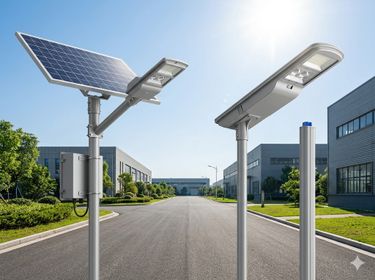
All-in-One Solar Street Light vs. Split Solar Street Light: A Configuration Comparison for Off-Grid Road Projects
Setting up a remote municipal project requires reliable illumination without grid dependency. When conducting an off-grid road lighting comparison, engineers and procurement teams often find themselves choosing between two dominant architectures. The decision impacts not only the initial capital expenditure but also the long-term operational resilience of the infrastructure. Are you better off deploying a sleek, integrated unit for immediate deployment, or does a modular approach provide the necessary resilience for your specific geographic demands? Let’s break down the technical realities of both setups.
How all-in-one solar street lights reduce installation labor vs. split systems
For general contractors and project managers, time on the job site directly translates to operational costs. The installation mechanics between these two systems present a stark contrast in required labor, lifting equipment, and technical expertise.
- Pre-wired simplicity: An all-in-one solar street light consolidates the LED module, lithium battery, charge controller, and solar panel into a single housing. This eliminates the need for on-site wiring, splicing, and waterproofing of external cable connections, drastically reducing the margin for human error during installation.
- Reduced hoisting cycles: Installing an integrated unit typically requires a single crane lift. The luminaire is sleeved directly onto the tenon of the light pole and secured. Conversely, split systems require multiple hoisting operations: securing the solar panel bracket, mounting the heavy battery box (either sub-surface or pole-mounted), and finally attaching the LED lamp head.
- Minimized structural assembly: Split systems arrive in multiple cartons and require ground crews to assemble complex mounting brackets for the photovoltaic (PV) panels. Integrated systems bypass this entirely, allowing a standard two-person municipal crew to install significantly more units per shift.
- Logistical footprint: Moving materials from the staging area to the installation site is highly streamlined with integrated systems. There are fewer individual components to track, reducing the risk of missing hardware or delayed deployments on remote stretches of road.
When split-system LiFePO₄ battery boxes offer longer autonomy for rainy-season projects
To truly understand system resilience in harsh climates, we must look beyond the initial installation and examine the energy storage and generation capacity. This is where a split system demonstrates its distinct engineering advantages. By decoupling the solar panel and the battery from the luminaire housing, manufacturers are no longer constrained by the physical dimensions of the lamp head.
In regions that experience prolonged monsoons or heavy winter cloud cover, maximizing LiFePO₄ solar street light autonomy is critical. A split system allows engineers to specify significantly larger photovoltaic panels and high-capacity battery banks. Because the panel is mounted independently, it can be precisely angled and oriented toward the equator to capture maximum solar irradiance, uncompromised by the angle of the road or the position of the LED fixture.
Furthermore, high-capacity Lithium Iron Phosphate (LiFePO₄) batteries require physical volume to house the necessary cells for a 5-to-7-day backup autonomy. In an integrated system, placing a massive battery directly behind the LED board creates severe thermal management challenges. A split system physically isolates the battery pack—often placing it in a ventilated pole-mounted enclosure or burying it underground—protecting the cells from the extreme heat generated by high-wattage LED chips and direct solar baking, thereby preserving battery health and extending the system's operational lifespan during continuous rainy seasons.
Comparing pole load weight between all-in-one and split solar street light setups
Structural integrity is a primary concern for municipal engineers, particularly in coastal or high-wind environments. The physical distribution of weight and the resulting wind drag area dictate the required specifications for the light poles themselves. Even when total project investments scale into the thousand-dollar range per unit for heavy-duty applications, failing to account for pole load dynamics can lead to catastrophic structural failures.
| Engineering Metric | All-in-One Architecture | Split System Architecture |
|---|---|---|
| Center of Gravity | Concentrated entirely at the top of the pole, creating a pendulum effect under high wind loads. | Distributed throughout the pole (panel at top, luminaire on an arm, battery often lower or underground). |
| Wind Drag Area (EPA) | Fixed horizontal surface area. Highly aerodynamic in standard conditions, but acts as a solid wing during severe updrafts. | Highly variable. The large, tilted independent solar panel acts as a significant sail, requiring high-gauge steel poles. |
| Pole Requirements | Can often utilize standard-gauge poles due to the overall lighter combined weight of the system. | Demands thicker, reinforced poles with deep foundational anchors to counter the torque generated by the large top-mounted panel. |
| Vibration Tolerance | High. The unified die-cast aluminum housing dampens micro-vibrations from passing heavy traffic. | Moderate. Multiple connection points and brackets require rigorous torque-checking to prevent loosening over time. |
Understanding this structural difference is crucial. The split solar street light configuration demands a much more robust, and consequently more expensive, pole infrastructure to safely support the separated components, particularly the large, angled photovoltaic array.
Thermal Management and Optical Performance
Moving beyond the physical footprint, the performance of the luminaire itself hinges on heat dissipation and precise light distribution. High-performance outdoor LED lighting relies heavily on managing the junction temperature of the LED chips.
- Die-cast aluminum housings: Premium fixtures utilize heavy-duty die-cast aluminum to draw heat away from the driver power supply and the LED array. In integrated systems, this housing must also act as a heat sink for the internal battery and solar panel, making thermal efficiency absolutely paramount to prevent the system from throttling its light output.
- Light distribution design: Optical lenses are critical for off-grid lighting to maximize every lumen produced. Whether utilizing a Type II, Type III, or Type V distribution, the optical lens ensures that light is pushed down the roadway rather than wasted in the surrounding environment.
- IP/IK Protection: Both configurations must adhere to strict environmental protections. High IP (water and dust resistance, typically IP66) and IK (impact resistance, typically IK08 or IK10) ratings ensure that the sensitive driver power supplies and intelligent lighting sensors survive both harsh weather and potential vandalism.
Which configuration do municipal maintenance teams prefer for long-term serviceability?
When evaluating the total cost of ownership, the maintenance protocol plays a decisive role. Municipal maintenance teams generally favor systems that allow for targeted, component-level troubleshooting rather than full-unit replacements.
In a split configuration, the modularity of the system is its greatest asset for long-term serviceability. If a solar panel is damaged by debris, or if a battery reaches the end of its lifecycle after seven years, a technician can replace that specific component without disturbing the rest of the installation. The LED luminaire and the charge controller remain untouched. This component-level isolation makes diagnosing issues straightforward—technicians can independently test the voltage of the panel, the battery, and the driver.
Conversely, maintaining an integrated fixture often presents a different paradigm. While modern fixtures feature tool-free maintenance designs that allow technicians to unlatch the housing and swap out a battery or controller on the pole, severe failures often require dismounting the entire luminaire head. If the integrated solar panel degrades or cracks, the whole unit is usually compromised, leading to a higher replacement cost. However, the integration of intelligent lighting options—such as IoT-based remote monitoring systems—has mitigated some of these challenges by allowing maintenance teams to remotely diagnose whether a failure is due to battery degradation or a faulty sensor before dispatching a bucket truck.
Conclusion
Ultimately, the choice between these systems depends on your project's specific geographic and budgetary constraints. Integrated units offer unparalleled installation speed and sleek aesthetics for corporate campuses and standard municipal roads. Meanwhile, split systems remain the undisputed choice for critical infrastructure in challenging climates where maximum energy generation and extended battery autonomy are non-negotiable.
At Infralumin, we leverage our deep collaboration with leading international component brands to manufacture top-tier outdoor LED lighting solutions. Whether your project demands the high-capacity resilience of a split system or the streamlined efficiency of an integrated unit, our OEM/ODM customization services ensure you receive products engineered with superior die-cast aluminum housings, advanced optical lenses, and rigorous quality control. Partner with us to build intelligent, off-grid lighting infrastructure that stands the test of time.
FAQ
What is the main difference in the split solar street light configuration?
The main difference is modularity. A split configuration separates the solar panel, battery pack, and LED luminaire into distinct components, allowing for larger panel sizing and flexible, directional installation compared to a unified, integrated fixture.
How long does a LiFePO₄ solar street light autonomy last during cloudy days?
When properly sized, especially within a split system architecture, LiFePO₄ batteries can provide 5 to 7 days of continuous nighttime autonomy during prolonged rainy or cloudy seasons without requiring a recharge.
Can an all-in-one solar street light be used for highway illumination?
Yes, high-wattage integrated units equipped with precision optical lenses and intelligent lighting controls are frequently used for highways, provided the geographic location receives adequate daily sunlight to sustain the high lumen output required for high-speed roadways.
Which system is better for hurricane-prone areas?
Integrated units often have a lower wind drag area (EPA) making them aerodynamically superior in high winds. However, if a split system is used, it must be paired with heavily reinforced, high-gauge steel poles to withstand the torque generated by the large, independent solar panel.
How does the off-grid road lighting comparison impact project budgets?
Integrated units lower upfront labor and installation costs due to their plug-and-play nature. Split systems often require higher initial capital for complex installation and heavier poles, but can offer long-term savings in harsh climates through cheaper, component-level replacements.

Zhongshan Lumin Technology Co., Ltd. is a renowned high-tech enterprise specializing in the research, development, and manufacturing of industrial LED lights.
Contact
@2026 Zhongshan Lumin Technology Co., Ltd.