

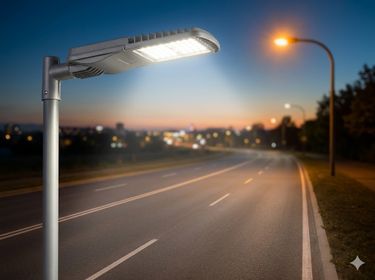
HPS to LED Street Light Retrofit: A Cost-Benefit and Technical Compatibility Guide for Municipal Road Projects
Municipalities worldwide are accelerating the shift toward energy-efficient lighting, but one question consistently arises: how do you execute an effective HPS to LED street light retrofit without compromising performance, compliance, or budget? While the promise of lower energy consumption and longer lifespan is compelling, the real challenge lies in technical compatibility, lighting standards, and financial justification. So, what does a successful retrofit actually involve—and how can project stakeholders avoid costly missteps?
Checking Pole and Arm Bracket Compatibility Before an LED Street Light Retrofit
Before specifying luminaires, a thorough site audit is essential. Retrofitting is not simply a luminaire swap—it’s an engineering exercise involving mechanical fit, electrical compatibility, and structural integrity.
Key Mechanical Compatibility Checks
Pole diameter and spigot size Most LED street lights support 48–60 mm standard spigots, but legacy poles may vary.
Arm bracket angle and outreach Incorrect tilt angles can distort light distribution, reducing road uniformity.
Load-bearing capacity LED fixtures are typically lighter than HPS, but windage (EPA rating) must still be validated.
Electrical and Wiring Considerations
- Input voltage range (commonly 100–277V or 347–480V)
- Existing cabling condition (aging insulation can compromise safety)
- Grounding compliance
Pre-Retrofit Site Survey Checklist (8-Point)
- Pole structural integrity
- Arm bracket compatibility
- Input voltage verification
- Wiring insulation condition
- Surge protection status
- Existing control system (photocell, timer, smart node)
- Mounting height consistency
- Environmental exposure (coastal, industrial zones)
A disciplined pre-survey minimizes installation delays and ensures the retrofit aligns with both safety codes and performance expectations.
LED Street Light Wattage Equivalency for 150W–400W HPS Replacement
One of the most common misconceptions in a municipal road lighting upgrade is assuming a 1:1 wattage replacement. LED systems deliver significantly higher luminous efficacy (typically 130–170 lm/W), enabling lower wattages to achieve equal or better illumination.
LED Street Light Wattage Equivalency Table
| HPS Wattage | Typical Lumens | LED Wattage | LED Lumens | CCT (K) | CRI |
|---|---|---|---|---|---|
| 150W | ~16,000 lm | 50–70W | ~8,000–11,000 lm | 3000–5000K | 70–80 |
| 250W | ~28,000 lm | 80–120W | ~12,000–18,000 lm | 3000–5000K | 70–80 |
| 400W | ~50,000 lm | 150–200W | ~22,000–30,000 lm | 3000–5000K | 70–80 |
Key Technical Differences
- Directional lighting: LEDs reduce wasted light (no omnidirectional loss)
- Color rendering: Higher CRI improves visibility and safety
- CCT flexibility: Adjustable CCT supports different road environments
Content Upgrade: Power Conversion Reference
For procurement teams, providing a downloadable quick reference PDF can streamline decision-making and standardize retrofit specifications across projects.
Payback Period Comparison: HPS Retrofit vs. Full LED Street Light Replacement
Financial viability remains a primary driver in municipal projects. According to International Energy Agency (IEA) data, street lighting accounts for up to 40% of a city's electricity consumption, making it a prime target for efficiency upgrades.
Cost-Benefit Breakdown
| Factor | HPS Retrofit | Full LED Replacement |
|---|---|---|
| Initial Cost | Low | Moderate |
| Energy Savings | 30–40% | 50–70% |
| Maintenance Cost | High | Low |
| Lifespan | 10,000–24,000 hrs | 50,000–100,000 hrs |
| Smart Control Compatibility | Limited | Fully compatible |
Embedded TCO Example (10-Year Lifecycle)
Scenario: Replace 150W HPS with 60W LED
- Annual operating hours: 4,200 hrs
- Energy cost: $0.12/kWh
HPS Energy Consumption: 150W × 4,200h = 630 kWh/year → $75.6/year
LED Energy Consumption: 60W × 4,200h = 252 kWh/year → $30.24/year
Annual Savings: $45.36 per fixture
Over 10 years:
- Energy savings: $453.6
- Maintenance savings (lamp + ballast replacement): ~$200–$300
Total savings per fixture: ~$650–$750
Typical municipal retrofit payback period: 3–6 years, depending on scale and utility tariffs.
Maintaining EN 13201 Road Class (M1–M6) Compliance During the HPS-to-LED Switch
Compliance with EN 13201 LED street light standards is non-negotiable in municipal road lighting upgrade projects. Transitioning from HPS to LED requires recalculating photometric performance—not just matching lumens.
Key Lighting Parameters
- Average luminance (cd/m²)
- Uniformity (U0, UL)
- Glare control (TI%)
- Surround ratio (SR)
EN 13201 Road Classes Overview
| Class | Road Type | Key Requirement |
|---|---|---|
| M1 | High-speed highways | Highest luminance & uniformity |
| M2–M3 | Major urban roads | Balanced performance |
| M4–M6 | Residential streets | Lower luminance, focus on efficiency |
Why LEDs Improve Compliance
LED street lights with precision optical lenses allow:
- Customized light distribution (Type II, III, IV)
- Reduced glare through advanced optics
- Better uniformity with fewer luminaires
A properly designed HPS to LED street light retrofit should include photometric simulation (Dialux/Relux) to validate compliance before installation.
Conclusion
A successful HPS to LED street light retrofit requires more than selecting efficient fixtures—it demands a coordinated approach across mechanical compatibility, photometric design, and lifecycle cost analysis. Municipalities that prioritize proper planning consistently achieve faster payback, improved road safety, and long-term operational savings.
For project developers and procurement teams, partnering with an experienced manufacturer like Infralumin ensures access to engineered optical systems, robust die-cast housings, and intelligent control-ready solutions tailored for demanding outdoor environments.
FAQ about LED street light
What is the biggest benefit of an HPS to LED street light retrofit?
The primary advantage is energy savings of 50–70%, combined with significantly reduced maintenance costs and longer lifespan.
How do I determine LED street light wattage equivalency?
Use lumen output rather than wattage. LED street light wattage equivalency depends on efficacy and optical efficiency, not just power consumption.
Can existing poles be reused in a municipal road lighting upgrade?
Yes, if they pass structural and dimensional checks. Pole and arm compatibility must be verified during the site survey.
How do LEDs meet EN 13201 requirements?
Modern LED luminaires use advanced optics to meet EN 13201 LED street light standards, ensuring proper luminance, uniformity, and glare control.
What is the typical ROI for LED street lighting projects?
Most municipal projects achieve payback within 3–6 years, depending on energy costs and maintenance savings.

Zhongshan Lumin Technology Co., Ltd. is a renowned high-tech enterprise specializing in the research, development, and manufacturing of industrial LED lights.
Contact
@2026 Zhongshan Lumin Technology Co., Ltd.