

Off-Grid Solar Street Lighting for Rural Infrastructure: A Project Engineer's Selection and Configuration Guide
1. Why Off-Grid Solar Lighting Demands a Different Evaluation Framework
Off-grid solar street lighting is not simply a grid-connected LED project with a battery attached. When a project site sits beyond the reach of reliable distribution infrastructure — a rural road corridor in Canada's Northern Territories, a township access route in the Peruvian highlands, or a resettlement community in northeastern Brazil — the entire TCO (total cost of ownership) model shifts. Grid extension cost, not lamp cost, becomes the dominant variable.
According to the International Energy Agency's Africa Energy Outlook (IEA, 2022) and the Inter-American Development Bank's rural electrification reports, extending medium-voltage grid infrastructure to a remote community can cost between USD 15,000 and USD 50,000 per kilometer, depending on terrain, voltage level, and permitting regime. For lighting-only loads spread over a 5–15 km rural corridor, this figure often renders grid extension economically indefensible on a 10-year horizon.
The result: solar street light projects are increasingly the baseline engineering choice — not an alternative — for rural road lighting in regions where annual solar irradiance exceeds roughly 3.5 peak sun hours (PSH) per day on average. That threshold covers most of Latin America, southern Europe, and broad zones in sub-Saharan Africa and South/Southeast Asia.
This shift in default assumption is consequential for how project teams structure procurement, specify equipment, and allocate contingency. It also means that the variables most likely to cause project failure are not luminaire performance metrics — they are battery sizing errors, incorrect autonomy assumptions, and inadequate pole foundation design for wind and soil conditions. The following sections address each of these in a structured way.
2. System Architecture Options and Their Trade-Offs
Remote area lighting for public infrastructure generally involves three solar street light system architectures. Understanding their mechanical, electrical, and maintenance differences is prerequisite to any procurement specification.
2.1 Split-Type Solar Street Lights (Panel + Separate Luminaire + Pole-Top or Ground Battery Box)
In split-type configurations, the solar panel, LED driver/luminaire, battery pack, and controller are distinct assemblies. The panel is typically mounted on a bracket at the top of a 6–10 m pole, angled to optimize irradiance capture. The battery is housed in a ground-level or mid-pole enclosure.
Advantages:
- Battery is accessible for inspection, replacement, or upgrade without dismounting the luminaire or panel.
- Larger panel surfaces (often 200–400 Wp) and higher battery capacities (100–200 Ah) are practical, enabling 3–5 nights of backup autonomy — critical for high-latitude projects in Canada where consecutive overcast days are common.
- Thermal management is easier: batteries housed outside the luminaire body run cooler, extending LiFePO₄ cycle life.
Limitations:
- Higher installation cost (separate cable runs, weatherproof enclosures, additional pole mounting hardware).
- Ground-level battery boxes are a target for vandalism in some contexts; mid-pole enclosures reduce risk but complicate replacement.
- Longer on-site assembly time per pole; for 50–200 unit rural projects, this affects labor scheduling significantly.
2.2 All-in-One (Integrated) Solar Street Lights
All-in-one systems integrate the panel, lithium battery, LED module, controller, and motion sensor into a single housing mounted at the pole top. They have become the dominant product form in solar street light projects for rural roads and community areas over the past five years, primarily because of installation speed and logistics simplicity.
Advantages:
- Pre-wired, pre-tested at factory; installation typically requires only pole mounting — no field wiring.
- Compact logistics footprint; shipping and customs classification simplified.
- Motion-sensing dimming (commonly 30–100% range) extends effective battery runtime by 30–50% on low-traffic rural roads, per typical specification sheets from mid-market product lines.
Limitations:
- Battery replacement requires dismounting the entire unit from the pole — a notable O&M cost driver over a 10-year project horizon.
- Panel size is constrained by the housing form factor, typically 30–80 Wp; this limits maximum light output and backup autonomy, usually to 1–2 nights. For high-latitude sites (above 50°N, such as much of Canada), this is often insufficient for winter months.
- Thermal cycling stress on batteries is higher when the battery is enclosed in a south-facing panel housing.
2.3 All-in-Two (Semi-Integrated) Solar Street Lights
A less common but increasingly adopted architecture for mid-scale projects: the panel and battery/controller are integrated into one housing mounted separately from the LED luminaire. This partially preserves split-type installation flexibility while maintaining some integration benefit.

3. Regional Scenario Analysis: Canada vs. South America
The selection logic for solar street light projects changes significantly between a high-latitude, low-irradiance region like Northern Canada and a high-irradiance equatorial or sub-equatorial zone like Brazil's Northeastern interior. Both present compelling use cases but require fundamentally different system parameters.
3.1 Northern Canada: Low PSH, High Autonomy Demand
Rural road lighting projects in provinces like Manitoba, Saskatchewan, and the Northwest Territories operate under some of the most demanding off-grid solar conditions:
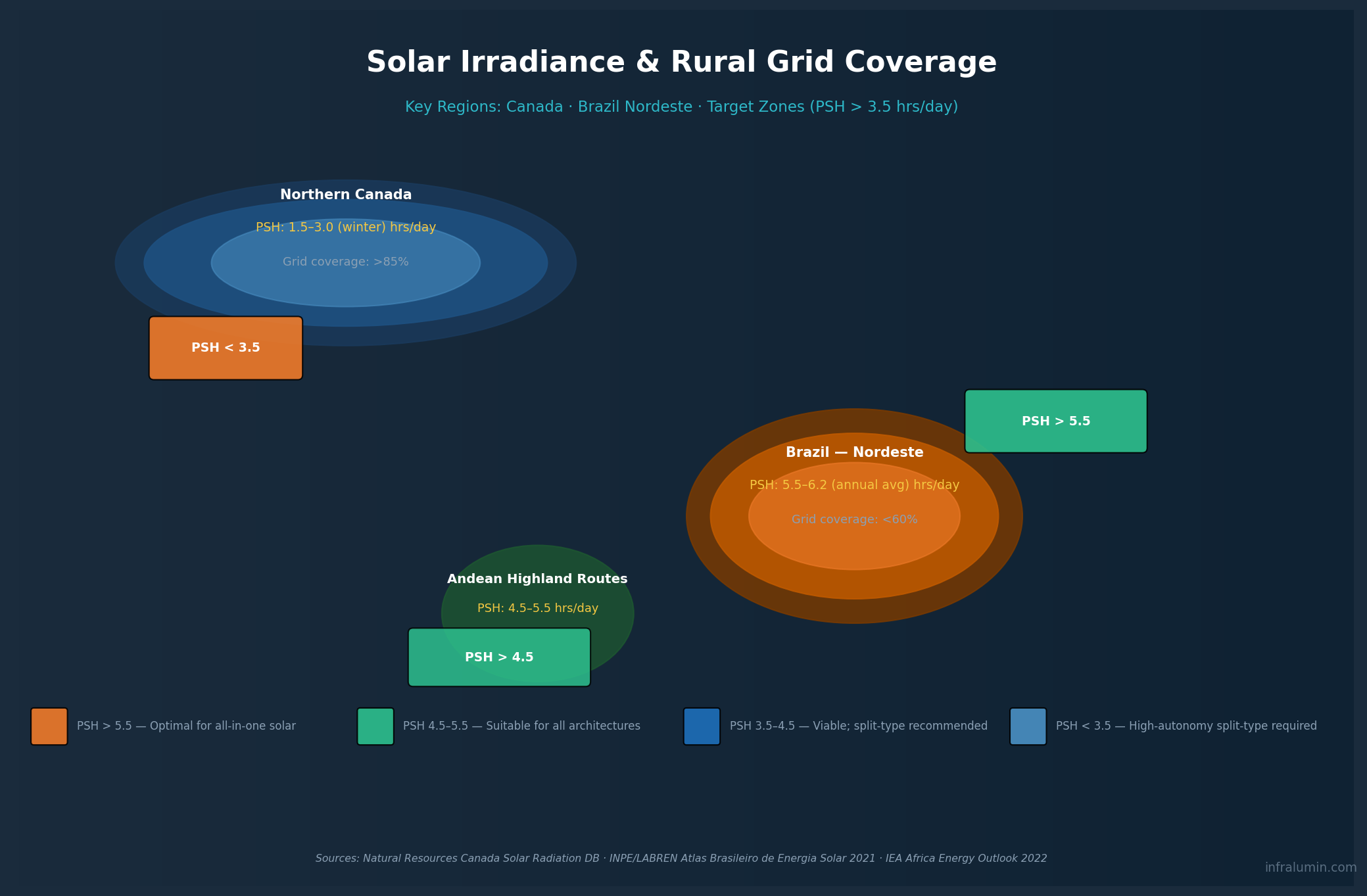
- Winter PSH: 1.5–2.5 hours/day in December–January (Natural Resources Canada solar radiation database)
- Consecutive overcast days: 5–10 days common in autumn transition periods
- Temperature range: −40°C to +35°C, requiring LiFePO₄ batteries with low-temperature charging protection circuits
- Wind loading: Significant; pole design must account for minimum 120 km/h gust load per NBC (National Building Code of Canada) for rural highway infrastructure
Under these conditions, engineers typically recommend:
- Split-type configurations with panel capacities of 300 Wp or greater per luminaire
- LiFePO₄ batteries sized for ≥5 nights of full-output autonomy (or 3 nights at dimmed output)
- Battery enclosures with built-in heating mats rated for −40°C operation
- 5–6 m mounting heights (lower than standard to reduce wind moment)
In practice, this means that a 30W LED luminaire in Northern Manitoba may require a 300 Wp panel and a 150 Ah/12V battery pack — roughly 3× the panel and 4× the battery capacity that the same luminaire would need in central Brazil. The all-in-one form factor is generally unsuitable for these conditions.
Relevant policy context: Indigenous and Northern Affairs Canada (INAC) and provincial programs such as Manitoba's Remote Community Electricity Subsidy have funded multiple rural solar road lighting pilot projects. Federal procurement for such projects typically requires CSA Group certification for electrical components and compliance with Environment and Climate Change Canada's extended producer responsibility framework for battery disposal.
3.2 Brazil's Northeast (Nordeste): High PSH, Cost-Efficiency Focus
Brazil's Nordeste region (Ceará, Piauí, Bahia, Rio Grande do Norte) offers some of the highest solar irradiance in South America:
- Annual average PSH: 5.5–6.2 hours/day (INMET / LABREN-INPE solar atlas data)
- Consecutive overcast days: Rarely exceeds 3 in the dry season (May–December); may reach 5–7 during the February–April rainy season
- Temperature range: +15°C to +42°C; battery thermal management is primarily about heat dissipation, not low-temperature protection
These conditions favor all-in-one solar street lighting systems with:
- 60–100 Wp panels
- 30–50W LED output
- 1.5–2 night autonomy (sufficient for the dry season; marginal in rainy season for critical roads)
- Simple pole-top mounting; no special thermal management hardware
Brazil's Programa Luz para Todos (Light for All) and subsequent programs under the Ministry of Mines and Energy have established a substantial procurement baseline for off-grid rural solar lighting. ANEEL (National Electric Energy Agency) oversees technical standards; INMETRO certification is generally required for electrical equipment imported or sold for public infrastructure use.
For an EPC contractor bidding on a 200-luminaire rural road project in Ceará, the all-in-one architecture typically delivers the lowest installed cost per point, provided the road traffic volume is low enough (under ~50 vehicles/hour at night) for motion-dimming to meaningfully extend battery runtime.

4. Decision Framework: Architecture and Specification Selection Matrix
The following comparison covers three system configurations under two representative project scenarios. All cost estimates are indicative ranges based on publicly reported project data and industry standard pricing as of 2023–2024; actual project pricing will vary with local logistics, tariff classification, and volume.
System Comparison Table
| Evaluation Dimension | Split-Type Solar System | All-in-One Solar System | All-in-Two Solar System |
|---|---|---|---|
| Typical panel capacity | 150–400 Wp | 30–100 Wp | 80–200 Wp |
| Battery autonomy (full output) | 3–7 nights | 1–2 nights | 2–4 nights |
| Installation time per pole | 60–90 min | 20–35 min | 35–55 min |
| Estimated installed cost (30W LED) | USD 350–600 | USD 180–320 | USD 260–430 |
| Battery replacement procedure | Ground-level; no climbing required | Full unit dismount from pole | Battery module dismount; no full unit removal |
| Suitable for high-latitude (>50°N) | ✓ Yes (with appropriate sizing) | ✗ Generally not (insufficient panel/battery) | Conditional (depends on panel size) |
| Suitable for tropical/subtropical | ✓ Yes (may be oversized) | ✓ Yes (optimal form factor) | ✓ Yes |
| Vandalism risk (battery) | Moderate (ground box) / Low (mid-pole) | Low (integrated top mount) | Low (top mount) |
| Logistics complexity | High (multiple SKUs per unit) | Low (single SKU) | Medium |
| Certification pathway (Canada) | CSA C22.2, ULC | CSA C22.2, ULC | CSA C22.2, ULC |
| Certification pathway (Brazil) | INMETRO, ABNT NBR | INMETRO, ABNT NBR | INMETRO, ABNT NBR |
| Recommended project scale | 50–500+ poles | 20–300 poles | 30–200 poles |
Cost ranges are indicative, based on 2023–2024 industry benchmark data from IFC/ESMAP procurement reports and regional EPC contractor quotations.
5. Procurement and Site Assessment Checklist for Rural Solar Lighting
Before finalizing any off-grid solar street light specification, engineers typically recommend a structured pre-procurement review covering the following items. This checklist is applicable to EPC contractors managing rural solar lighting project delivery.
Site & Solar Resource Assessment
- Confirm annual average PSH from a validated data source (PVGIS for Europe, INPE/LABREN for Brazil, Natural Resources Canada Solar Radiation Database for Canada)
- Identify worst-month PSH (the month with the lowest average; this governs battery autonomy sizing, not annual average)
- Record maximum consecutive overcast days observed in local historical weather data (minimum 10-year record)
- Confirm site latitude and winter solstice day length to assess panel tilt angle and shading risk
Structural and Environmental Conditions
- Obtain local wind speed design value (reference gust, 50-year return period) per applicable national standard (NBC in Canada, ABNT NBR 6118 in Brazil)
- Determine soil classification at pole foundation locations (required for foundation design per local civil standards)
- Assess salt mist, dust, or humidity exposure — confirm minimum IP65 for luminaire, IP66 for battery enclosures in coastal or high-dust environments
- Confirm operating temperature range and select battery chemistry accordingly (LiFePO₄ recommended for −20°C to −40°C; GEL not recommended below −10°C continuous)
System Specification
- Define required lux levels at road surface (reference: CIE 115:2010 for road lighting; IES RP-8 for North America)
- Specify minimum Color Rendering Index (CRI ≥ 70 for public road safety; CRI ≥ 80 for community/pedestrian areas)
- Confirm required autonomy days and derate battery capacity for end-of-life condition (LiFePO₄ at 80% of rated capacity is the standard derate for 5-year cycle life calculations)
- Verify motion-dimming profile compatibility with expected traffic volume (dimming to 30% on low-traffic roads is common; confirm minimum lux maintained during dimmed mode still meets safety standard)
Compliance and Certification
- Confirm applicable electrical certification mark (CSA for Canada, INMETRO for Brazil, CE + relevant national mark for Europe)
- Verify battery disposal and end-of-life compliance with local environmental regulation
- Request IES LM-80 photometric test data and IES LM-79 luminaire performance data from equipment provider
6. Illustrative TCO Calculation: 100-Pole Rural Road Project, Brazil Nordeste
The following calculation illustrates the TCO logic for comparing grid extension versus all-in-one solar street lighting for a 100-pole, 5 km rural road lighting project in Ceará, Brazil. All assumptions are stated explicitly and should be adjusted to project-specific conditions.
Assumptions:
- Road length: 5 km, pole spacing: 50 m → 100 poles
- Required luminaire output: 30W LED equivalent
- Grid extension cost estimate: BRL 120,000–180,000/km (based on ANEEL low-voltage extension benchmarks, 2022)
- Grid electricity tariff for public lighting: BRL 0.65/kWh (ANEEL 2023 average for public lighting class)
- All-in-one solar unit installed cost: USD 260/unit × BRL 5.0 exchange rate = BRL 1,300/unit
- Battery replacement (year 7 estimated): BRL 300/unit
- Grid-connected LED luminaire installed cost: BRL 800/unit (excluding grid extension)
- Maintenance cycle: solar — annual inspection BRL 50/unit; grid — bi-annual lamp/driver check BRL 80/unit/year
10-Year TCO Comparison (100 poles):
| Cost Component | Grid-Connected LED | Off-Grid Solar (All-in-One) |
|---|---|---|
| Grid extension (5 km × BRL 150,000/km avg.) | BRL 750,000 | — |
| Luminaire + installation (100 units) | BRL 80,000 | BRL 130,000 |
| Annual energy cost (30W × 12h × 365 × 100) | BRL 85,410/yr → BRL 854,100 over 10 yr | — |
| Battery replacement (Year 7, 100 units) | — | BRL 30,000 |
| O&M over 10 years | BRL 80,000 | BRL 50,000 |
| 10-Year TCO (indicative) | BRL 1,764,100 | BRL 210,000 |
Interpretation: When grid extension costs are factored in, off-grid solar street lighting is substantially more cost-competitive on a 10-year horizon for this scenario. However, this advantage narrows considerably if the road is on a grid extension corridor that will serve multiple loads beyond lighting (irrigation pumps, community facilities), in which case the grid extension cost should be allocated across all benefiting loads rather than charged entirely to the lighting project.

When project conditions shift, shorter road lengths (1–2 km from existing grid), very dense pole spacing, or sites where grid extension has already been committed for other reasons, the economics can favor grid-connected LED. Engineers should run the TCO model with project-specific inputs before finalizing the system choice.
Conclusion
For rural and remote-area road lighting projects, the fundamental engineering question is not "solar or grid?" but rather: what does the grid extension actually cost, and does the solar autonomy requirement match the local solar resource? When grid extension exceeds approximately USD 10,000–15,000 per kilometer and the site averages at least 3.5 PSH/day year-round, solar street light systems typically deliver a lower 10-year TCO with acceptable reliability — provided the battery is sized for worst-month conditions, not annual averages.
The split-type configuration remains the technically preferred choice for high-latitude or high-autonomy-requirement projects (Canada, Nordic Europe, high-altitude Andean routes). The all-in-one architecture offers the most cost-efficient solution for tropical and sub-tropical projects where PSH is consistently above 4.5 and battery autonomy requirements are modest.
Procurement teams should prioritize verified solar resource data, third-party certified equipment, and a battery replacement strategy as part of the O&M budget. If you need a system configuration evaluation for your solar street light project, please contact Infralumin street light technical team for a customized solution.
References
- International Energy Agency (IEA) · Africa Energy Outlook 2022 · 2022 · https://www.iea.org/reports/africa-energy-outlook-2022
- Inter-American Development Bank (IDB) · Rural Electrification in Latin America: Lessons from Two Decades of Bank Support · 2020 · https://publications.iadb.org
- Natural Resources Canada · Photovoltaic Potential and Solar Resource Maps of Canada · (Solar Radiation Database, updated periodically) · https://www.nrcan.gc.ca/maps-tools-and-publications/tools/modelling-tools/canmetenergy/pvmap
- INPE / LABREN · Atlas Brasileiro de Energia Solar, 3ª Edição · 2021 · http://labren.ccst.inpe.br/atlas_3rd.html
- ANEEL (Agência Nacional de Energia Elétrica) · Tarifas de Energia Elétrica — Classe Iluminação Pública · 2023 · https://www.aneel.gov.br
- IFC / ESMAP (World Bank Group) · Off-Grid Solar Market Trends Report 2022 · 2022 · https://www.esmap.org/off-grid-solar-market-trends-report-2022
- CIE (International Commission on Illumination) · CIE 115:2010 — Lighting of Roads for Motor and Pedestrian Traffic · 2010
- INMETRO · Programa Brasileiro de Etiquetagem — Luminárias · https://www.inmetro.gov.br

Zhongshan Lumin Technology Co., Ltd. is a renowned high-tech enterprise specializing in the research, development, and manufacturing of industrial LED lights.
Contact
@2026 Zhongshan Lumin Technology Co., Ltd.