

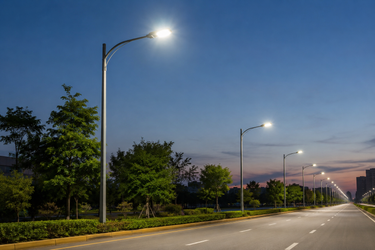
LED Street Light Retrofit vs Replacement: Which Option Is Better for Municipal Lighting Projects?
A municipal lighting upgrade rarely starts with a simple question like “Which LED fixture should we buy?” More often, the real challenge is deciding what to do with thousands of existing street lights. If the poles are still structurally sound, an LED Street Light Retrofit may reduce project costs and installation time. If the existing fixtures are outdated, damaged, or poorly suited to modern lighting requirements, full LED Street Light Replacement may be the smarter long-term investment.
So, how should municipalities, contractors, and lighting engineers decide between the two?
LED Street Light Retrofit vs Replacement: Key Differences
The biggest difference is straightforward: a retrofit upgrades the existing lighting system, while replacement removes the old fixture and installs a new LED street light.
With an LED Street Light Retrofit, the existing housing, pole, or mounting structure may remain in place. Depending on the fixture design, the LED module, driver, optics, or internal components can be upgraded. This approach can be attractive when existing infrastructure is still in good condition.
A full LED Street Light Replacement takes a more comprehensive approach. The existing luminaire is removed and replaced with a purpose-built LED fixture designed around current efficiency, thermal management, optical performance, and control requirements.
| Factor | LED Street Light Retrofit | LED Street Light Replacement |
|---|---|---|
| Existing fixture | Usually retained or partially reused | Fully replaced |
| Initial installation work | Generally lower | Generally higher |
| Project disruption | Usually limited | May require more installation work |
| Lighting performance | Depends on existing housing and optics | Designed specifically for LED performance |
| Smart controls | Depends on compatibility | Easier to specify as part of a new system |
| Long-term flexibility | Varies by fixture | Typically higher |
| Best suited for | Sound existing infrastructure | Aging or unsuitable fixtures |
The decision should therefore go beyond the initial equipment price. Municipalities should consider energy consumption, maintenance requirements, expected service life, photometric performance, compatibility with controls, and the total cost of ownership.
When Should You Choose LED Street Light Retrofit?
An LED Street Light Retrofit can make sense when the existing infrastructure is fundamentally usable but the lighting technology has become outdated.
For example, a municipality may have a large number of conventional fixtures mounted on poles that are still structurally sound. Replacing every fixture, mounting component, and related hardware may add unnecessary labor and material costs. A carefully selected retrofit can modernize the lighting system while preserving usable infrastructure.
A retrofit is particularly worth considering when:
- Existing housings are in good physical condition and provide adequate protection.
- Pole spacing and mounting arrangements already meet project requirements.
- The existing electrical infrastructure can support the upgraded LED system.
- The municipality wants to reduce energy consumption without completely rebuilding the lighting system.
- Installation time and traffic disruption need to be minimized.
- The existing fixture can accommodate suitable LED modules, drivers, and optical components.
However, compatibility should never be assumed simply because a retrofit kit physically fits the old fixture. The LED module, driver, thermal system, optics, and housing need to work together.
Heat is a particularly important consideration. LEDs may be highly efficient, but poor heat dissipation can accelerate component degradation and reduce expected service life. An existing enclosure that was never designed for modern LED thermal requirements may limit the benefits of an otherwise efficient retrofit.
Electrical compatibility is another concern. Drivers must match the LED system's voltage, current, dimming requirements, and control architecture. For municipal projects using photocells, DALI, D4i, sensors, or networked controls, compatibility should be evaluated before installation.
When Is Full LED Street Light Replacement Better?
There are situations where keeping the old fixture simply creates limitations. If the housing has corrosion, water ingress, mechanical damage, poor heat dissipation, or outdated optics, a complete LED Street Light Replacement can provide a cleaner and more reliable solution.
Full replacement is generally more appropriate when:
- Existing luminaires have reached the end of their useful life.
- Corrosion, cracks, water ingress, or structural deterioration are present.
- Existing optics produce poor uniformity, glare, or excessive light spill.
- The current fixture cannot support the desired LED output or control system.
- The project requires new CCT, dimming, sensing, or smart-lighting capabilities.
- The municipality wants a standardized fixture platform for future maintenance.
- Lighting requirements have changed because of road reconstruction or urban development.
A new LED street light also gives engineers greater freedom to optimize the complete optical and thermal system rather than adapting new components to an old housing.
For large municipal projects, standardization can be especially valuable. Using a consistent family of LED street lights can simplify spare-parts management, maintenance training, procurement, and future expansion.
That does not mean replacement is automatically better. A complete replacement usually involves higher upfront equipment and installation costs. The stronger case for replacement comes when the new fixture delivers measurable improvements in efficiency, maintenance, lighting quality, durability, and system flexibility over its service life.
Why Lighting Design Matters in LED Street Light Retrofit Projects
A successful Street Lighting Retrofit is not simply a matter of installing a higher-lumen LED source.
Road geometry, pole height, pole spacing, mounting angle, road width, traffic conditions, pedestrian activity, and surrounding buildings all influence the required lighting performance. The wrong optical distribution can create bright spots directly beneath fixtures while leaving darker areas between poles.
This is why photometric analysis should be part of the planning process. Engineers can evaluate parameters such as illuminance, luminance, uniformity, glare, and light distribution before deciding on the final fixture and optical configuration.
The LED system should also be matched to the application. A narrow roadway may require a different distribution from a wide urban road, intersection, parking area, or pedestrian zone.
Other design considerations include:
- Optical distribution: Select lenses and beam patterns according to road geometry rather than relying only on lumen output.
- CCT selection: Choose an appropriate correlated color temperature based on municipal requirements, surroundings, visibility, and project objectives.
- Thermal management: Ensure the housing and heat sink can effectively dissipate heat under local environmental conditions.
- Surge protection: Outdoor luminaires should be designed to withstand electrical disturbances common in exposed installations.
- IP and IK protection: The enclosure should provide appropriate protection against water, dust, and mechanical impact.
- Smart controls: Dimming, photocells, motion sensors, DALI/D4i systems, and networked controls can be incorporated when the project requires adaptive lighting.
For this reason, a Municipal LED Lighting Upgrade should begin with an assessment of the existing system and the target lighting performance—not simply a comparison of fixture wattages.
Infralumin LED Street Lighting Solutions
For municipalities and contractors evaluating an LED Street Lighting Upgrade, fixture selection should balance efficiency with reliability, optical performance, maintainability, and future expandability.
Infralumin develops outdoor LED lighting solutions for commercial, industrial, and public applications, with LED street lighting as one of its core product categories. Its solutions can be configured for different road and outdoor environments while supporting requirements such as high-efficiency LED performance, durable housings, high IP/IK protection, and flexible control options.
For municipal projects, several technical features can be particularly valuable.
Durable construction: Die-cast aluminum housings provide mechanical strength while helping transfer heat away from LED components. High IP and IK protection can help the luminaire withstand demanding outdoor environments.
Maintenance-friendly design: Tool-free or simplified maintenance features can reduce the time required for inspection and component servicing, which matters when a project involves hundreds or thousands of fixtures.
Flexible lighting configuration: Different optical distributions and adjustable CCT options allow engineers to match the lighting system more closely to project requirements instead of using a one-size-fits-all configuration.
Smart lighting compatibility: Sensor and control options can support dimming, scheduling, adaptive lighting, and energy-management strategies where the municipal infrastructure calls for them.
OEM/ODM support: Large projects often involve specific mounting requirements, electrical configurations, control systems, or branding requirements. OEM/ODM capabilities allow the lighting solution to be adapted to project specifications rather than forcing the project to fit a standard product.
Ultimately, the right choice between retrofit and replacement depends on the condition of the existing fixtures, project requirements, installation constraints, and long-term operating goals. A professional assessment can reveal whether existing infrastructure is worth preserving or whether a purpose-built LED system will deliver better value.
For municipalities planning a new project or upgrading aging street lighting, Infralumin can provide project-oriented LED street lighting solutions designed around performance, durability, and long-term maintenance needs.
Conclusion
Choosing between LED Street Light Retrofit and full replacement is a project decision, not simply a product decision. Retrofit can be a practical way to modernize sound infrastructure, while replacement offers greater flexibility when existing fixtures can no longer meet today's performance and control requirements.
The best solution is the one that delivers reliable illumination, manageable maintenance, lower energy consumption, and long-term value. For your next municipal lighting project, work with Infralumin to develop an LED street lighting solution tailored to your application's technical and operational needs.
FAQ
What is an LED Street Light Retrofit?
An LED Street Light Retrofit upgrades an existing street lighting fixture with compatible LED components, such as an LED module, driver, or optical system, while retaining some existing infrastructure.
What is LED Street Light Replacement?
LED Street Light Replacement means removing the existing luminaire and installing a new purpose-built LED street light designed for modern efficiency, optical performance, durability, and control requirements.
Is LED Street Light Retrofit cheaper than replacement?
An LED Street Light Retrofit can have lower upfront installation costs when existing housings and infrastructure are still in good condition. However, total cost should also include maintenance, compatibility, energy savings, and expected service life.
When is full LED Street Light Replacement recommended?
Full replacement is generally better when existing fixtures are damaged, corroded, inefficient, difficult to maintain, or unable to support the required optical performance and smart lighting controls.
Why is lighting design important for a Municipal LED Lighting Upgrade?
Lighting design determines whether the upgraded system provides appropriate illumination, uniformity, glare control, and light distribution for the actual road and surrounding environment.
Can an LED Street Lighting Upgrade include smart controls?
Yes. Depending on the project, an LED Street Lighting Upgrade can incorporate photocells, sensors, dimming, DALI/D4i, and other intelligent control technologies.

Zhongshan Lumin Technology Co., Ltd. is a renowned high-tech enterprise specializing in the research, development, and manufacturing of industrial LED lights.
Contact
@2026 Zhongshan Lumin Technology Co., Ltd.