

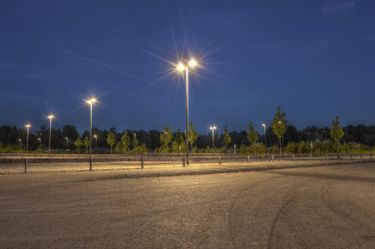
Selecting LED Street Lights for Urban Roads
Urban road lighting is not decorative infrastructure. It is a controlled engineering system shaped by road hierarchy, traffic behavior, safety targets, and regulatory constraints. Effective LED street light selection starts with understanding how lighting design parameters change across different urban road classes, then translating those requirements into lumen output, optical distribution, and glare control strategies that align with road lighting standards.
Urban Road Lighting Design Based on Road Class and Pole Height
Urban street lighting design varies significantly between expressways, arterial roads, collector roads, and local streets. Higher-class roads prioritize visibility at speed, longer viewing distances, and consistent luminance across multiple lanes. Lower-class roads focus more on pedestrian safety, visual comfort, and spatial orientation.
Pole height is directly linked to road width, lane count, and mounting configuration. Arterial roads typically use higher poles, often between 8 and 12 meters, to achieve broader coverage and reduce the number of fixtures. Residential or local roads commonly use 6–8 meter poles to limit light spill and maintain human-scale illumination. In urban street lighting design, pole height, arm length, and fixture tilt must be considered together. Changing one parameter without recalculating the others often leads to poor uniformity or excessive glare.
Road lighting standards in many regions define minimum luminance or illuminance levels based on road class. These standards act as the baseline, not the optimization target. LED street light selection should aim to meet standards with margin, while minimizing wasted light outside the roadway.
LED Street Light Lumen Output and Uniformity Requirements
Lumen output alone does not define lighting quality. Over-specified lumen packages can increase energy consumption and glare without improving road safety. The correct approach is to match lumen output to road width, pole spacing, mounting height, and required lighting class.
Uniformity is a critical performance indicator in road lighting standards. Poor uniformity creates alternating bright and dark zones, increasing driver fatigue and reducing obstacle detection. LED street light selection must therefore focus on how light is distributed on the road surface, not just total output. Proper spacing-to-height ratios and matched optical distributions are essential for achieving longitudinal and transverse uniformity.
Modern LED street lighting systems allow precise control over lumen packages, enabling designers to avoid the traditional “one-wattage-fits-all” approach. This flexibility supports energy-efficient urban street lighting design while maintaining compliance with regulatory requirements.
Street Light Optics and Glare Control for Urban Roads
Street light optics determine where photons land. In urban environments, this matters as much for what is not illuminated as for what is. Poor optical control results in light trespass into buildings, skyglow, and discomfort glare for drivers and pedestrians.
Optical lens design should align with road geometry. Asymmetric street light optics are commonly used to direct light along the roadway rather than outward or upward. Cut-off angles and shielding play a key role in glare control, especially on multi-lane roads and intersections. Excessive glare reduces contrast perception, undermining the benefits of higher light levels.
Effective LED street light selection balances optical efficiency with visual comfort. Compliance with road lighting standards related to glare, such as threshold increment or unified glare rating where applicable, should be verified during the design stage, not after installation.
Making Informed LED Street Light Selections for Urban Projects
Selecting LED street lights for urban roads is a systems decision. Urban street lighting design must integrate road class analysis, pole configuration, lumen planning, uniformity targets, and optical control into a coherent whole. Treating fixtures as isolated products rather than components of a lighting system leads to inconsistent performance and higher lifecycle costs.
For project planners, municipalities, and contractors seeking reliable solutions, working with an experienced LED street light manufacturer simplifies this process. Infralumin offers a comprehensive range of LED street lighting products designed to support different urban road classes, optical requirements, and compliance needs. Their solutions are engineered to align with road lighting standards while supporting efficient, scalable LED street light selection for modern urban environments.

Zhongshan Lumin Technology Co., Ltd. is a renowned high-tech enterprise specializing in the research, development, and manufacturing of industrial LED lights.
Contact
@2026 Zhongshan Lumin Technology Co., Ltd.