

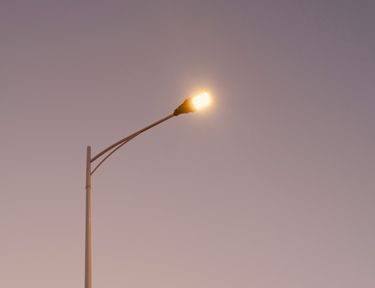
Why Solar Street Lights with Radar Sensors Fit High-Traffic Roads
High-traffic roads impose contradictory demands on lighting systems. Illumination must remain reliable, responsive, and safe at all hours, yet energy efficiency and operating cost control are increasingly non-negotiable. Radar sensor solar street lights sit precisely at this intersection. By combining off-grid solar power with motion-aware control, they address traffic intensity, variability, and sustainability in a single system.
Radar Sensor Solar Street Light for High-Traffic Roads
A radar solar street light uses microwave radar technology to detect movement across a wide area, regardless of ambient light conditions, weather, or dust. Unlike traditional infrared motion sensor solar lights, radar sensors can identify fast-moving vehicles and pedestrians at longer distances and wider angles. This capability makes them particularly suitable for high-traffic roads, arterial streets, industrial zones, and logistics corridors where vehicle speed and traffic density fluctuate throughout the day and night.
For urban planners and municipal engineers, this matters because traffic patterns are rarely constant. Peak hours demand full illumination for safety, visibility, and compliance with road lighting standards, while off-peak hours do not require the same light output. Radar solar street lighting adapts dynamically without human intervention, ensuring that lighting performance aligns with real-world road usage.
Motion-Based Dimming in Smart Solar Street Lighting
Motion-based dimming is the operational core of smart solar street lighting. In a typical adaptive solar lighting configuration, the luminaire maintains a low-power baseline output when no motion is detected. Once radar sensing identifies approaching vehicles or pedestrians, the system instantly increases brightness to full or near-full output, then gradually dims again after the area clears.
This continuous adjustment offers two advantages. First, it preserves safety on high-traffic roads by ensuring adequate illumination exactly when and where it is needed. Second, it significantly reduces unnecessary energy consumption during low-traffic periods such as late nights or early mornings.
Radar-based motion sensor solar lights excel here because they do not require a direct line of sight and are less prone to false triggers from temperature changes or minor environmental movement. The result is a stable, predictable lighting behavior that supports both road safety and long-term system reliability.
Energy Savings with Radar Solar Street Lights
Energy efficiency is not a secondary benefit; it is the economic rationale behind adopting radar solar street lights at scale. Solar energy generation is finite, constrained by panel size, weather conditions, and seasonal daylight variations. Adaptive solar lighting extends system autonomy by optimizing how stored energy is consumed.
By reducing full-power operation time, radar solar street lighting lowers battery discharge cycles, prolongs battery lifespan, and minimizes maintenance frequency. Over the lifecycle of a high-traffic road lighting project, these savings translate into reduced replacement costs, fewer service interventions, and improved return on investment.
From a sustainability perspective, smart solar street lighting also aligns with municipal carbon reduction targets. Lower energy waste means better utilization of renewable power and less dependence on oversized panels or battery systems, making projects more scalable and environmentally coherent.
Practical Application with Infralumin SSE03 Solar Street Light
For projects requiring a balance between intelligent control, durability, and consistent lighting performance, the Infralumin SSE03 Solar Street Light provides a practical reference. Designed for roadway and infrastructure applications, it integrates radar sensor control to support adaptive solar lighting strategies on high-traffic roads.
The SSE03 solar street light enables motion-based dimming without compromising illumination stability, helping municipalities and contractors achieve energy savings while maintaining road safety standards. Its design supports long operating hours, efficient solar charging, and reliable performance in variable traffic environments.
When applied to urban roads, industrial parks, or transit corridors, Infralumin as a professional radar solar street lights factory demonstrate how smart solar street lighting can move beyond basic illumination and become an active component of modern traffic infrastructure.

Zhongshan Lumin Technology Co., Ltd. is a renowned high-tech enterprise specializing in the research, development, and manufacturing of industrial LED lights.
Contact
@2026 Zhongshan Lumin Technology Co., Ltd.