

Meeting Tender Requirements for Solar Street Lighting: A Complete Procurement Guide
Infralumin Procurement Advisory Team · March 2026 Updated · 18 min read
Winning a solar street lighting tender is not simply about offering the lowest unit price. Municipal procurement officers, EPC project managers, and World Bank-funded project administrators increasingly apply multi-dimensional evaluation criteria that reward technical compliance, verified quality, and long-term warranty commitment over short-term cost savings.
Yet many suppliers and distributors still approach solar lighting bids with a one-page datasheet and a price list. That approach worked a decade ago. It rarely works today.
This guide draws on Infralumin's direct experience supporting solar lighting procurement across Southeast Asia, Sub-Saharan Africa, and the Middle East and North Africa region. We have reviewed hundreds of published municipal tender documents, organized their most common technical requirements, and translated that research into a practical reference that buyers and suppliers can use together.
Whether you are a procurement officer setting bid specifications, an EPC contractor preparing a compliant submission, or a distributor building a supply chain for a World Bank project, this article gives you the framework to navigate solar street light tender requirements with confidence.
Section 1: Understanding Municipal Solar Street Lighting Tender Specifications
What Municipal Buyers Actually Specify
Public sector procurement documents for solar street lights typically organize technical requirements into four categories: photometric performance, electrical system specification, structural and mechanical standards, and environmental ratings.
Photometric Performance
Most municipal tenders specify minimum illuminance levels in lux, measured at road surface level, or minimum luminous flux in lumens at the lamp head. Typical requirements for a residential road include an average horizontal illuminance of 10 to 15 lux with a uniformity ratio of at least 0.25. Collector and arterial roads typically require 20 to 30 lux average with a uniformity ratio above 0.35.
Common photometric terms you will encounter in tender documents include:
- Maintained Average Illuminance (Em): the average lux level across the road surface after applying a light loss factor for luminaire depreciation over the maintenance cycle.
- Uniformity Ratio (Uo): the ratio of minimum illuminance to average illuminance. A ratio of 0.4 or above indicates even light distribution without dark patches.
- Colour Rendering Index (CRI): municipal tenders increasingly specify CRI above 70 or 80 to ensure road users can distinguish colours accurately for safety purposes.
Electrical System Specification
Solar street light tender specifications for municipalities typically define the complete off-grid system, not just the luminaire. Key electrical parameters to expect include:
- Solar panel minimum wattage and efficiency. Many recent tenders specify monocrystalline panels with minimum 20% module efficiency, which excludes lower-grade polycrystalline products.
- Battery chemistry and capacity. Lithium iron phosphate (LiFePO4) chemistry is now the dominant requirement in professional procurement documents because of its superior cycle life and thermal stability compared to lead-acid or standard lithium alternatives. Typical specifications require capacity to support three to five consecutive nights of operation at rated output without solar recharging. This is known as the autonomy period.
- Controller and protection features. Specifications routinely require overcharge protection, over-discharge protection, short-circuit protection, and temperature compensation. Bluetooth or remote monitoring capability is increasingly required for smart city projects.
Structural and Mechanical Standards
Pole wind load resistance is almost always specified as a minimum wind speed in metres per second, typically 36 to 55 m/s depending on the region. Hot-dip galvanizing to a minimum zinc coating of 85 micrometres is standard for corrosion protection. Foundation specifications reference the anchor bolt size and concrete grade corresponding to each pole height.
Environmental Ratings
Ingress protection requirements have risen steadily. IP65 is the current minimum for most tenders. Projects in coastal, humid tropical, or desert environments increasingly specify IP67. The LED driver, controller, and battery compartment must each carry their own certified IP rating, not a single system-level claim.
High-Frequency Tender Clauses: What Appears Most Often in Public Documents
Based on a review of publicly available tender documents from TED (Tenders Electronic Daily), the World Bank procurement notices portal, and the African Development Bank project database, the following technical clauses appear most frequently:
Clause Type and Typical Requirement
- Minimum LED luminous efficacy: 150 lm/W or above at the LED package level (not system level)
- Minimum panel efficiency: 20% for monocrystalline; 18% for high-efficiency polycrystalline
- Battery autonomy period: 3 consecutive nights minimum; 5 nights for critical infrastructure
- Rated lifespan of LED module: 50,000 hours minimum at L70 (lumen maintenance of 70% or above)
- Colour temperature: 3000K to 4000K for residential; 4000K to 5700K for commercial and road applications
- Structural wind resistance: 40 m/s in standard zones; 55 m/s in typhoon or high-wind zones
- Anti-theft features: tamper-resistant access panels; cable entry sealing; battery compartment locking
- Warranty period: luminaire body 5 years minimum; LED module 3 to 5 years; battery 3 years minimum
Section 2: Warranty and Lifespan Clauses That Win Bids
Warranty clauses are among the most scrutinized sections of any solar lighting procurement evaluation, particularly for projects financed by development banks or government infrastructure funds. Evaluators use warranty terms as a proxy for supplier confidence in their own product quality.
What a Strong Warranty Statement Covers
A warranty statement submitted with a solar street light tender bid should address five distinct components.
Luminaire Body and Housing
A minimum of five years against defects in materials, workmanship, and corrosion of the housing. For projects in coastal environments, specify that the warranty covers salt-spray corrosion in accordance with IEC 60068-2-52 test conditions.
LED Module and Driver
A minimum of three years, with many competitive bids offering five years. The warranty should reference lumen maintenance: for example, "LED module maintains minimum 70% of initial lumen output (L70) for 50,000 operating hours under rated operating conditions." This ties the warranty to a measurable performance standard rather than a vague "defect-free" claim.
Battery Pack
A minimum of three years or 1,500 charge cycles to 80% residual capacity, whichever comes first. For LiFePO4 chemistry, leading factories typically offer 2,000 cycles, which supports a five-year warranty if the battery completes one full cycle per day.
Solar Panel
A product warranty of ten years against manufacturing defects and a performance warranty of 25 years guaranteeing minimum 80% of rated output. These terms follow standard photovoltaic industry practice established by tier-one panel manufacturers.
Structural Components
A minimum of ten years against corrosion of the hot-dip galvanized coating, with specific reference to the zinc coating thickness in micrometres tested in accordance with ISO 1460.
How Warranty Terms Affect Bid Evaluation Scores
In price-plus-quality evaluation frameworks (commonly used in World Bank and Asian Development Bank projects), warranty terms are typically scored within a "technical merit" envelope that represents 30 to 50% of the total evaluation score. A supplier offering a five-year LED warranty versus a competitor offering two years may score ten to fifteen additional points on a 100-point scale, which frequently offsets a price difference of 8 to 12%.
This means that a solar street light factory capable of offering genuine multi-year warranties backed by factory certification is not simply a premium supplier. It is a structurally more competitive bidder in quality-weighted evaluation systems.
Section 3: Compliance Documents Required for Outdoor Solar Lighting Projects
Incomplete documentation is the single most common reason technically qualified solar street light bids are disqualified at the administrative review stage. The following documents are required across the majority of municipal and EPC solar lighting tenders.
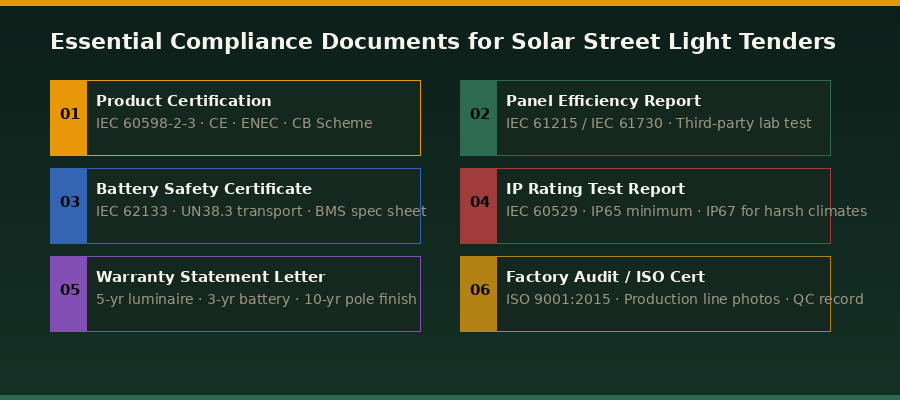
Document Checklist by Category
Product Certification
IEC 60598-2-3: luminaire standard specific to road and street lighting. CE marking (mandatory for European and many Middle Eastern government projects). CB Scheme certification for mutual recognition across participating countries. ENEC or KEMA marks for projects in European municipal markets.
Solar Panel Test Reports
IEC 61215: crystalline silicon terrestrial photovoltaic modules, design qualification and type approval. IEC 61730: safety qualification. Reports must be issued by an accredited third-party laboratory (TUV, Bureau Veritas, SGS, or equivalent). Self-declared test results are routinely rejected.
Battery Certification
IEC 62133: secondary lithium cells and batteries for portable applications. UN38.3: transport testing for lithium batteries, required for shipping documentation and increasingly for tender submissions. A battery management system (BMS) specification sheet showing protection thresholds for overcharge, over-discharge, overcurrent, and temperature.
IP Rating Test Report
IEC 60529 test report confirming the stated IP rating. The test report must identify each sub-component (driver housing, battery compartment, connector entry) separately if they carry different IP ratings.
Warranty Statement Letter
A signed letter on company letterhead from the manufacturer (not the distributor) specifying warranty periods by component, the claim process, replacement lead times, and applicable governing law. Tenders for government projects typically require this to be an original signed document, not a photocopy.
Factory Certification and Quality Records
ISO 9001:2015 certificate from the manufacturing entity, not a holding company. Photographs of the production line and quality control inspection stations are increasingly required for World Bank and AIIB-funded projects. A factory audit report from a recognized third-party inspection body (SGS, Bureau Veritas, Intertek) strengthens the submission significantly.
Section 4: Regional Market Comparison — Southeast Asia, Africa, and the Middle East
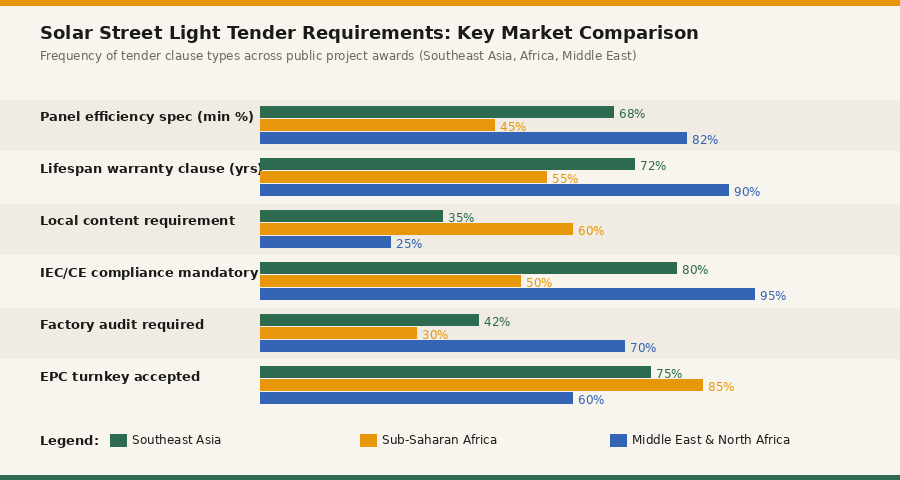
Solar street lighting tender requirements differ meaningfully across the three primary emerging-market regions where off-grid solar road lighting sees the greatest deployment volume. Understanding these differences helps suppliers and EPC contractors prepare region-appropriate bid packages.
Southeast Asia
Government solar street lighting procurement in Southeast Asia (Philippines, Vietnam, Indonesia, Thailand, and Cambodia are the five highest-volume markets) emphasizes photometric compliance and local content requirements for larger projects.
The ASEAN Smart Cities Network framework has influenced newer specifications toward connected luminaires with dimming schedules, remote monitoring, and energy reporting. Tenders increasingly require data export in open formats compatible with city management platforms.
Warranty periods are moderate by global standards: three years for LED modules and two years for batteries are typical in Philippine and Vietnamese government bids. Panel efficiency of 20% or above is specified in roughly 68% of reviewed tenders.
Local content requirements apply in Indonesia under the TKDN framework, requiring a minimum local content percentage that affects component sourcing decisions for large-scale projects. EPC contractors operating in Indonesia should factor this into their factory selection criteria.
Sub-Saharan Africa
African Development Bank, World Bank IDA, and bilateral aid-funded solar street lighting projects dominate the procurement landscape in Sub-Saharan Africa. This shapes the documentation requirements significantly: World Bank projects require compliance with the Procurement Regulations for IPF Borrowers (2020 edition) and typically mandate international competitive bidding for contracts above threshold values.
A distinctive feature of African solar lighting tenders is the high weight given to battery autonomy. Given grid instability and longer periods of cloud cover in some regions, five-night autonomy specifications are more common than in other markets. Tenders from Rwanda, Ghana, Senegal, and Nigeria consistently require this extended autonomy period.
Local content requirements appear in approximately 60% of reviewed Sub-Saharan tenders, the highest of the three regions. However, the definition of "local content" varies: some tenders accept local assembly with imported components, while others require a percentage of locally manufactured parts.
IEC/CE compliance is mandatory in 50% of reviewed tenders, lower than other regions, which partly reflects the prevalence of bilateral procurement (e.g., Chinese EPC projects under government-to-government agreements) where alternative certification frameworks are accepted.
Middle East and North Africa
MENA region solar street lighting procurement, particularly in Saudi Arabia, UAE, Oman, Qatar, and Morocco, applies the most rigorous technical standards of the three regions reviewed.
IEC and CE compliance is mandatory or strongly preferred in approximately 95% of reviewed tenders. Factory audit requirements appear in 70% of bids, more than twice the frequency observed in Southeast Asia. Warranty expectations are also higher: five years for LED modules and three years for batteries is the baseline, with premium projects specifying seven and five years respectively.
Solar panel efficiency requirements are the strictest globally: minimum 21% efficiency for monocrystalline panels is specified in many Saudi Aramco and NEOM-adjacent infrastructure projects. This effectively excludes entry-level panel suppliers from the supply chain.
EPC turnkey project structure is accepted in 60% of MENA tenders reviewed. However, a significant proportion of public works tenders in Saudi Arabia and Qatar require the EPC contractor to subcontract installation to locally registered companies, which affects project cost modelling.
Section 5: How to Work With a Qualified Solar Street Light Factory for Tender Success
The choice of manufacturing partner is a strategic decision in solar lighting procurement. A factory that can produce compliant products is necessary but not sufficient. The factory must also be able to provide the documentation, certifications, and technical support that professional tender submissions require.
What to Verify Before Selecting a Factory
Certification Currency
Verify that IEC test reports and ISO certificates are valid (not expired) and cover the specific product model you intend to bid with. A factory may hold IEC 60598 certification for one luminaire model but not for the integrated solar street light variant. Request the certificate scope document, not just the certificate front page.
Production Capacity and Lead Time
Municipal contracts often include delivery milestone penalties. Confirm the factory's monthly production capacity for the specific product, the current order backlog, and the confirmed lead time in writing before including the factory in a bid. A factory that promises 4,000 units per month but currently operates at 80% capacity can realistically commit to that volume. A factory at 100% capacity cannot.
Technical Support for Bidding
A qualified factory should be able to provide: photometric simulation files (using DIALux or Relux software) for the specific road geometry in your project; customized datasheet versions meeting the specific technical parameters in the tender; co-signed warranty letters on both factory and distributor letterhead; and technical point-of-contact availability during the bid preparation period.
Factory Audit Availability
For projects that require a factory audit report, confirm whether the factory has a standing relationship with SGS, Bureau Veritas, or Intertek for third-party audits, and the typical turnaround time. Some projects require audit completion before bid submission, which means the audit must be scheduled weeks in advance.
Infralumin Factory Partnership Model
Infralumin solar street light manufacturing facility in China holds ISO 9001:2015 certification and maintains current IEC 60598, IEC 61215, IEC 62133, and CE documentation for all standard product lines. We provide bid support services including DIALux photometric simulation, customized compliance documentation packages, co-signed warranty letters, and third-party audit coordination through Bureau Veritas.
For EPC contractors, distributors, and government procurement teams with active tender requirements, we offer a dedicated bid preparation consultation at no charge. Contact our technical team at sales6@infralumin.com or visit infralumin.com to begin the process.
Conclusion: Tender Compliance as a Competitive Advantage
Rigorous tender compliance is not bureaucratic overhead. It is a competitive differentiator that separates suppliers who win recurring government and EPC contracts from those who submit and lose repeatedly.
The municipalities, development banks, and infrastructure funds that finance solar street lighting projects are managing public money. They apply detailed evaluation criteria precisely because they need to justify their selections to auditors and citizens. Suppliers and EPC contractors who understand this dynamic and build their submissions accordingly gain a structural advantage that compounds over time through a track record of compliant, on-time delivery.
The practical steps are clear: study the published tender documents for your target markets, ensure your factory partner holds current certifications, prepare complete documentation packages for every component category, and price your warranty terms to reflect genuine manufacturing confidence rather than commercial caution.
If you are currently preparing a solar street lighting tender submission and need technical documentation support, production capacity confirmation, or photometric simulation for your specific road geometry, contact the Infralumin team. We work with procurement professionals, EPC contractors, and distributors across more than 40 countries and understand the documentation requirements that win bids in your market.
Product catalogue: https://infralumin.com/collection/led-lighting-brand
Request a bid support consultation: https://infralumin.com/pages/led-luminaire
Author Bio
The Infralumin technical and sales team has supported solar street lighting procurement across more than 40 countries since 2012. Our engineers hold expertise in IEC photometric standards, off-grid system design, and international tender documentation requirements. All guidance published on this site reflects direct experience with active government and EPC procurement processes.
References
- IEC 60598-2-3:2020. Luminaires for road and street lighting.
- IEC 61215:2021. Terrestrial photovoltaic (PV) modules, design qualification and type approval.
- IEC 62133-2:2017. Secondary cells and batteries containing alkaline or other non-acid electrolytes.
- World Bank Procurement Regulations for IPF Borrowers, July 2016, revised November 2020.
- TED (Tenders Electronic Daily), European Union Official Journal. Public procurement notices, 2022 to 2024.
- African Development Bank Procurement Policy Framework, 2021 edition.
- IESNA RP-8-14: Roadway Lighting, Illuminating Engineering Society of North America.

Zhongshan Lumin Technology Co., Ltd. is a renowned high-tech enterprise specializing in the research, development, and manufacturing of industrial LED lights.
Contact
@2026 Zhongshan Lumin Technology Co., Ltd.