

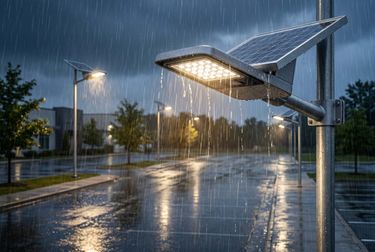
Does Rain Ruin Solar Lights? Understanding the Impact
As municipalities and commercial facilities transition toward sustainable off-grid infrastructure, the reliability of outdoor illumination during severe weather often becomes a primary concern for project engineers. A frequent question raised during the procurement phase is: does rain ruin solar lights? The short answer is no, provided you invest in commercial-grade fixtures engineered specifically for extreme outdoor environments. However, understanding the exact mechanisms behind this resilience is crucial for lighting designers, electrical contractors, and municipal buyers. From optical performance under dense cloud cover to the structural integrity of die-cast aluminum housings, achieving true weather resistance requires a highly integrated approach to luminaire design. Evaluating these systems goes far beyond simply looking at wattage; it involves assessing smart controllers, advanced battery chemistries, and uncompromising structural seals. How exactly do these advanced systems maintain uninterrupted, high-lumen illumination through consecutive days of torrential downpours?
How Solar Panels Function in Rain
When heavy storm clouds roll in and precipitation begins, a common misconception is that photovoltaic energy generation comes to a complete halt. In reality, the high-efficiency monocrystalline silicon panels utilized in industrial luminaires continue to function, albeit at a reduced electrical capacity. Solar cells do not strictly require direct, blinding sunlight to excite electrons; they possess the capability to generate electricity from diffuse light that scatters and refracts through rain clouds.
While the total energy harvest might drop by 70% to 80% compared to a perfectly clear summer afternoon, modern engineering compensates for this deficit. High-end systems utilize Maximum Power Point Tracking (MPPT) controllers. These sophisticated algorithms continuously adjust the electrical operating point of the photovoltaic modules, aggressively pulling the maximum possible wattage even when sunlight is heavily filtered by atmospheric moisture. Consequently, a well-engineered fixture can still trickle-charge its internal storage during a sustained thunderstorm. Furthermore, seasonal downpours provide a highly beneficial natural maintenance mechanism. Rain effectively washes away accumulated dust, industrial particulate matter, and bird droppings that gradually degrade panel efficiency over time. This self-cleaning process ensures that once the skies clear, the photovoltaic array instantly operates at peak optical transmittance without requiring municipal maintenance crews to dispatch bucket trucks to manually wipe down the fixtures.
Waterproofing and IP Ratings Explained
Evaluating the moisture resilience of any commercial lighting fixture begins with an in-depth understanding of Ingress Protection (IP) ratings. This standard, defined by the International Electrotechnical Commission (IEC), classifies the degree of protection provided by a mechanical casing against both solid particles and liquid intrusion. The two-digit system is paramount for specifying the correct outdoor fixture for a designated climate zone.
Evaluating IP65 Solar Lights Weather Resistant Capabilities
For commercial and municipal projects, a rating of IP65 is universally recognized as the baseline engineering standard. To be deemed truly reliable, an IP65 solar lights weather resistant design must successfully prevent low-pressure water jets from any direction from compromising the internal LED chips, drivers, or controllers. When deploying public lighting in regions prone to heavy monsoons or tropical storms, specifying engineers may opt to step up to an IP66 rating, which safeguards the delicate electronics against powerful, high-pressure water jets and heavy seas. The integrity of these IP ratings relies entirely on precision manufacturing tolerances.
| IP Rating | Solid Particle Protection (First Digit) | Liquid Ingress Protection (Second Digit) | Recommended Application |
|---|---|---|---|
| IP65 | Dust-tight (Complete protection) | Protected against low-pressure water jets | Standard commercial parking lots, public pathways |
| IP66 | Dust-tight (Complete protection) | Protected against powerful water jets | Highway lighting, coastal areas, storm zones |
| IP67 | Dust-tight (Complete protection) | Protected against temporary immersion | Specialized industrial sites, flood-prone terrain |
Preventing Water Ingress
Structural Design of Waterproof Solar Street Lights
While an IP rating dictates the standardized testing environment, the actual prevention of moisture intrusion in the field relies heavily on the physical engineering and material selection of the waterproof solar street lights. For demanding industrial applications, standard plastic or extruded aluminum housings are wholly inadequate. They degrade rapidly under prolonged UV exposure and warp during severe temperature fluctuations, which eventually breaks the internal sealing barriers. To guarantee long-term weatherproofing, premium luminaires employ several distinct structural strategies:
- Die-Cast Aluminum Housings: Utilizing high-pressure die-cast aluminum ensures a rigid, warp-free enclosure. This dense metal acts as a highly efficient heat sink for the LED chips and provides the necessary structural rigidity to keep waterproof gaskets perfectly compressed under severe wind shear.
- Premium Sealing Gaskets: Standard rubber deteriorates quickly outdoors. Industrial-grade fixtures utilize custom-molded silicone or EPDM (Ethylene Propylene Diene Monomer) gaskets. These materials retain their high elasticity over decades, preventing capillary action from drawing moisture into the optical lens chamber.
- Tool-Free Maintenance Latches: To facilitate rapid diagnostics without compromising the seal, modern fixtures are designed with heavy-duty, tool-free stainless steel latches. This ensures that maintenance technicians apply consistent, perfectly distributed pressure across the entire gasket upon closing, eliminating the human error associated with unevenly torqued screws.
- Integrated Drainage Channels: The exterior geometry of the luminaire is purposefully drafted with slight slopes and drainage grooves. This architectural design ensures that standing rain naturally flows off the surface and away from critical mechanical seams and the fragile edges of the photovoltaic panel.
Battery Care During Wet Seasons
Managing the Solar Battery in Rain for Longevity
The most critical vulnerability of any off-grid lighting network is not the light engine or the solar panel, but the energy storage component. Sustaining a solar battery in rain and prolonged cloudy periods requires precise thermal management and intelligent power distribution. If an energy storage system is repeatedly drained to absolute zero during a week of storms, its overall chemical lifespan will be severely truncated.
- LiFePO4 Chemistry: Lithium Iron Phosphate (LiFePO4) has rapidly become the undisputed standard for outdoor off-grid applications. Unlike traditional lead-acid or standard lithium-ion, LiFePO4 battery packs are inherently thermally stable, virtually eliminating the risk of combustion. They also boast an exceptional cycle life, safely enduring over 2,000 to 3,000 deep charge cycles.
- Oversized Capacity for Autonomy: To guarantee uninterrupted municipal illumination, industrial fixtures are mathematically engineered with a battery capacity that supports 5 to 7 days of full autonomy. This calculated overhead means the street light can operate at required safety brightness levels through an entire week of heavy rain without ever receiving a full sunlight charge.
- Intelligent Battery Management Systems (BMS): A sophisticated internal BMS actively monitors input voltage, output current, and core temperature. During wet seasons, it physically prevents over-discharging by meticulously tracking the Depth of Discharge (DoD) and isolating the battery if the cell voltage drops to a critical, damage-inducing threshold.
- Adaptive Smart Dimming: Paired with the MPPT controller, the system utilizes adaptive dimming protocols triggered by microwave or PIR motion sensors. By operating at a lower lumen output (e.g., 30%) when no pedestrians or vehicles are actively present, the unit conserves massive amounts of power. Many advanced smart systems also feature adjustable color temperatures (CCT), allowing operators to shift to warmer color spectrums that better cut through dense rain and fog.
Best Practices for Installation
Even the most technologically advanced waterproof solar street lights can succumb to environmental damage if improperly installed at the project site. Electrical contractors and municipal engineers must adhere strictly to established site planning guidelines to maximize both rainwater drainage and solar energy harvest.
- Optimized Tilt Angles: Solar arrays must never be installed perfectly horizontal. Depending on the local geographic latitude, a tilt angle of at least 10 to 15 degrees is mandatory. This exact pitch not only aligns the panel with the sun's seasonal trajectory but also ensures rapid water shedding, actively preventing rain pooling that could degrade the panel's edge sealants over time.
- Avoidance of Micro-Shadows: Pre-installation Dialux simulations must account for the full future growth canopy of nearby foliage and the moving shadows cast by adjacent architecture. Even a minuscule shadow covering a corner of a panel during a rainy day can disproportionately cripple the already limited diffuse light harvest.
- Precise Torque Specifications: When mounting the fixture to the pole arm, all slip-fitters and mounting brackets must be tightened to the manufacturer's exact torque specifications. In heavy rain accompanied by gale-force winds, excessive vibration can loosen internal electrical components or compromise external sealing points if the luminaire is not rigidly secured.
Conclusion
Ultimately, heavy precipitation and severe weather do not spell disaster for properly engineered off-grid lighting systems. By integrating highly efficient monocrystalline panels, intelligent MPPT charge controllers, robust high-IP enclosures, and deep-cycle LiFePO4 energy storage, modern luminaires are fully equipped to handle the rigorous demands of the wet season. For municipalities, lighting designers, and commercial developers, the key to success lies in selecting a manufacturing partner that refuses to compromise on material quality and structural execution. At Infralumin, we specialize in OEM/ODM customization of commercial and industrial LED lighting solutions. Our engineering-grade outdoor fixtures feature rugged die-cast aluminum housings, elite IP and IK protection ratings, and tool-free maintenance designs specifically crafted for absolute reliability. Whether you are illuminating a remote coastal highway or a high-traffic industrial complex, Infralumin delivers smart, weather-defying lighting that ensures public safety and operational efficiency, 365 nights a year.
Frequently Asked Questions (FAQs)
Will waterproof solar street lights work if they are completely submerged?
While industrial fixtures with an IP67 rating can withstand temporary immersion in shallow water without immediate failure, they are not engineered for continuous underwater operation. Standard IP65 or IP66 models will eventually suffer catastrophic water ingress if completely submerged, so they must always be mounted well above historical flood lines.
How does the performance of a solar battery in rain differ from normal conditions?
During heavy rain, the battery does not receive a high-current charge due to the lack of direct solar radiation. Instead, it relies on a slow trickle charge harvested from diffuse light. Its discharge rate is then aggressively managed by a smart MPPT controller that frequently dims the LEDs to conserve stored energy, ensuring the light persists through the night.
Are IP65 solar lights weather resistant enough for hurricane zones?
An IP65 rating ensures complete protection against dust ingress and low-pressure water jets, which is more than sufficient for standard heavy rainstorms. However, for hurricane or typhoon-prone coastal zones, upgrading the specification to an IP66 rating is highly recommended to withstand the powerful, wind-driven water jets characteristic of severe tropical cyclones.
Does rain ruin solar lights if the external casing cracks?
Yes. If a physical impact—such as flying storm debris or severe hail—cracks the luminaire's aluminum housing or the solar panel's tempered glass, the internal electronics become immediately vulnerable. Rainwater will bypass the engineered silicone seals, leading to rapid component corrosion, electrical short circuits, and complete system failure. This is why high IK08 or IK10 impact ratings are equally as important as IP ratings.
Do I need to clean my solar panels after a heavy rainstorm?
Generally, no. One of the primary benefits of heavy rainfall is its natural self-cleaning effect, which effectively washes away accumulated dirt, dust, and debris. Unless the storm violently deposits heavy mud, wet leaves, or branches directly onto the panel array, dispatching a crew for manual cleaning is usually unnecessary.

Zhongshan Lumin Technology Co., Ltd. is a renowned high-tech enterprise specializing in the research, development, and manufacturing of industrial LED lights.
Contact
@2026 Zhongshan Lumin Technology Co., Ltd.